A distributor stops at your stand and asks one question: are you registered to sell in Saudi Arabia? At a medical show that question decides everything.
If the answer is yes, you may have just met a year of orders. If the rep does not capture which market he asked about, you will never know which of your two hundred contacts he was.
At a healthcare show the value of a lead is not how interested someone seemed. It is whether you can legally sell to them, in their market, with the approvals they need. That is regulatory fit, and it is the filter that separates a real opportunity from a friendly conversation.
This guide covers the 2027 dates and the rename you need to know about, then the checklist that tells a high-value medical buyer from a browser, and how to capture it before the buyer walks on.
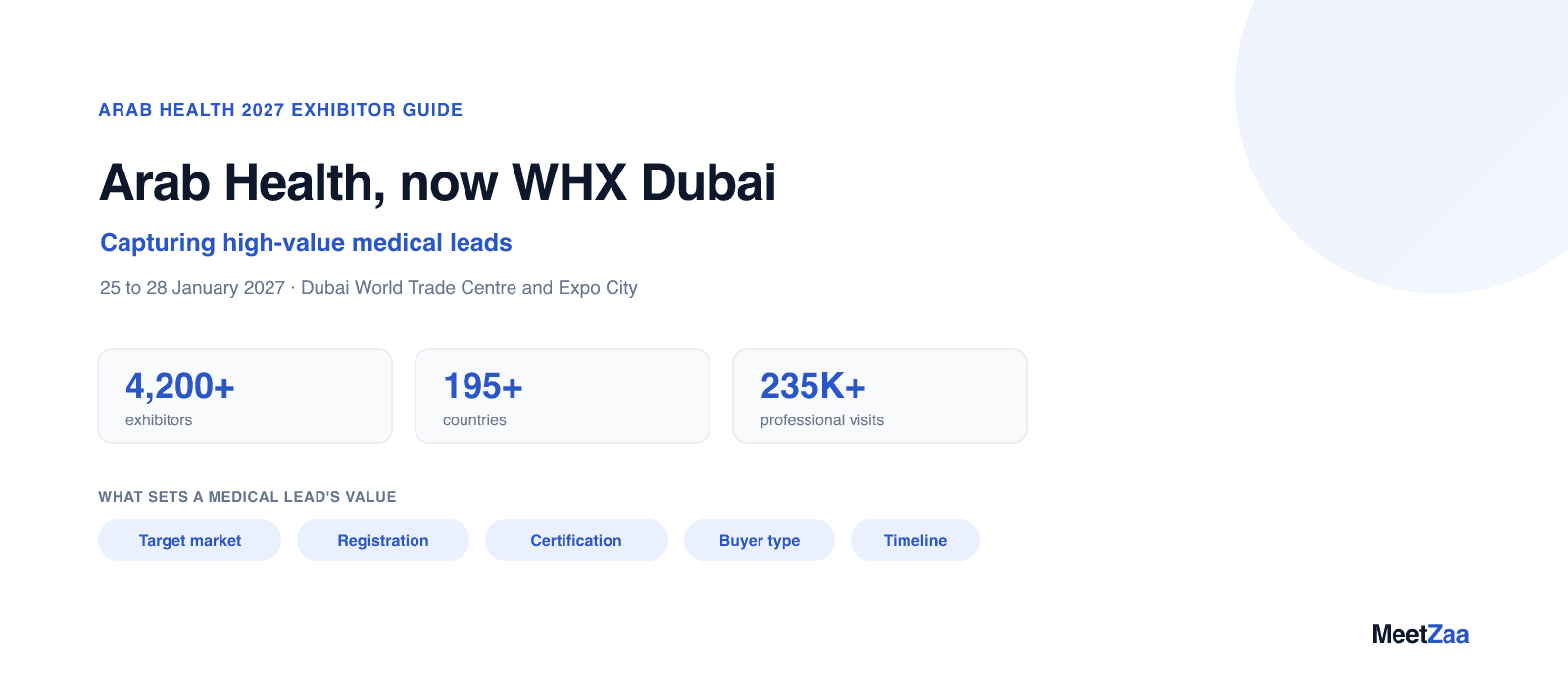
Arab Health is now WHX Dubai, and bigger
The first thing to know is the name. Arab Health was renamed World Health Expo (WHX) Dubai at its fiftieth edition in 2026. It is the same show, most people still search for it as Arab Health, and this guide uses both names.
The 2027 edition runs from 25 to 28 January 2027, and like the region's other giants it now spreads across two venues, the Dubai Exhibition Centre at Expo City and the Dubai World Trade Centre. The official figures put it at more than 4,200 exhibitors from over 195 countries.
professional visits at WHX Dubai 2027, formerly Arab Health, across two venues
The buyers are what make it worth the trip: hospital and clinic procurement, regional distributors and importers, group purchasing organisations, and tender agents buying for public health systems. These are high-value, low-volume relationships, where one distributor can open a whole market.
That changes how you work the floor. A consumer show rewards volume, so you talk to everyone. A medical show rewards fit, so you spend real time on fewer people and qualify them hard, because the buyers who matter are rare and each one is worth a great deal.
At a medical show, regulatory fit is the lead
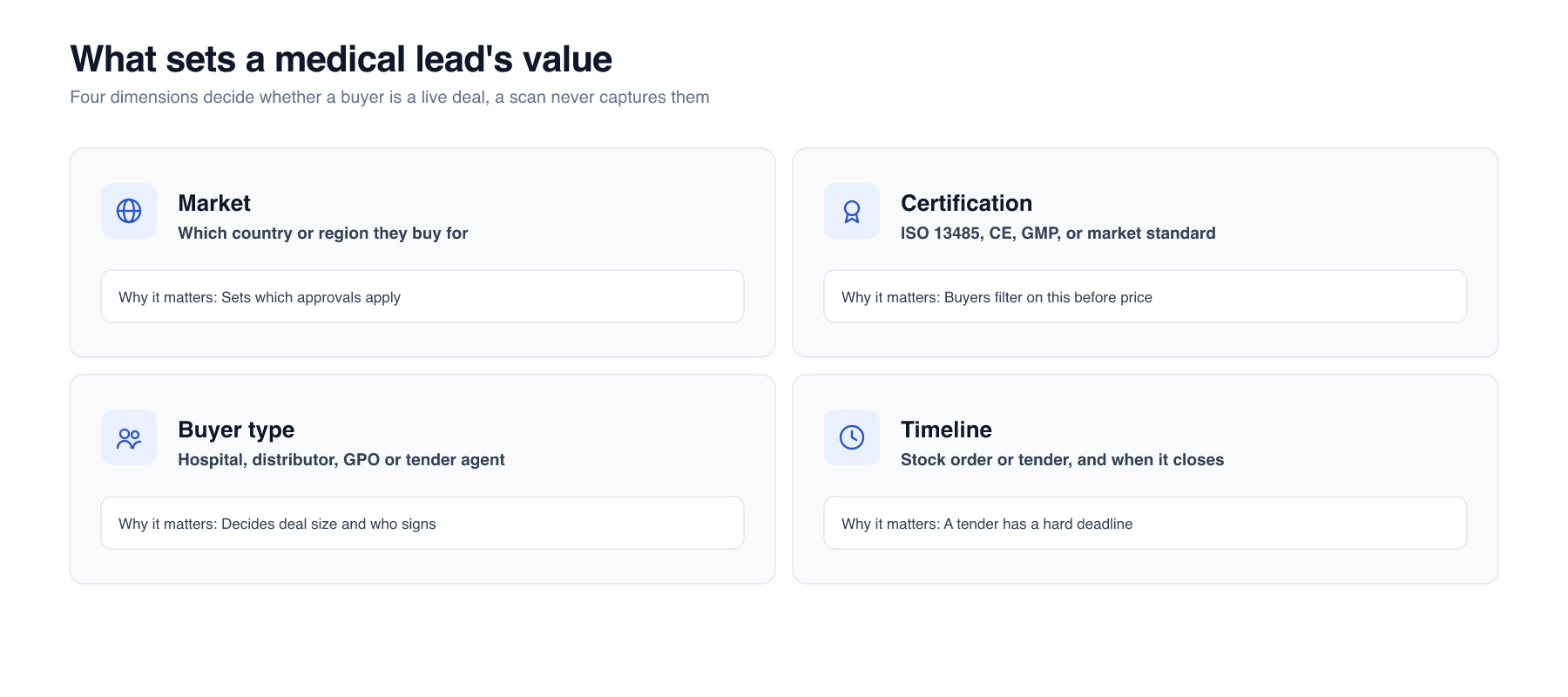
At a general trade show, interest is a decent signal. At a medical show it is not enough, because a buyer who loves your product but operates in a market where you are not registered cannot buy it yet. The value of the lead is set by regulatory fit, and that has four dimensions.
![What sets a medical lead's value: market, certification, buyer type and timeline]
The market decides which approvals apply. A device sold into Saudi Arabia needs registration with the Saudi regulator, the UAE has its own, and Europe and the US have theirs.
The certifications decide whether you clear the bar at all: a quality standard such as ISO 13485, a CE mark, or good manufacturing practice for pharma. The buyer type decides the deal shape, and the timeline decides whether it is this budget cycle or the next.
Get the four right and you know, before the buyer leaves, whether this is a deal to chase now or a relationship to build for later.
None of that is on a badge. It lives in the two minutes of conversation, and if it is not captured there, a high-value lead is indistinguishable from a low one by the time you are home.
The regulatory-buyer qualification checklist
Run every serious conversation through the regulatory-buyer qualification checklist. It is five questions, and the answers are what make a medical lead worth a follow-up, or not.
| Qualifier | What to capture | Why it decides the deal |
|---|---|---|
| Target market | Which country or region they buy for | Sets which registration and approvals apply |
| Registration status | Whether you are registered there, or they need you to be | A market you cannot sell into yet is not a live deal |
| Certification required | ISO 13485, CE, GMP, or a market-specific standard | Buyers filter suppliers on this before price |
| Buyer type | Hospital procurement, distributor, GPO, or tender agent | Decides deal size, terms and who signs |
| Volume and timeline | Stock order or tender, and when it closes | A tender has a hard deadline you cannot miss |
The checklist does two things. It tells your rep, in the moment, whether this is a buyer worth time now or a contact to nurture. And it captures the exact detail your follow-up will need, so the reply answers the regulatory question the buyer actually asked.
Why the checklist must be captured on the stand
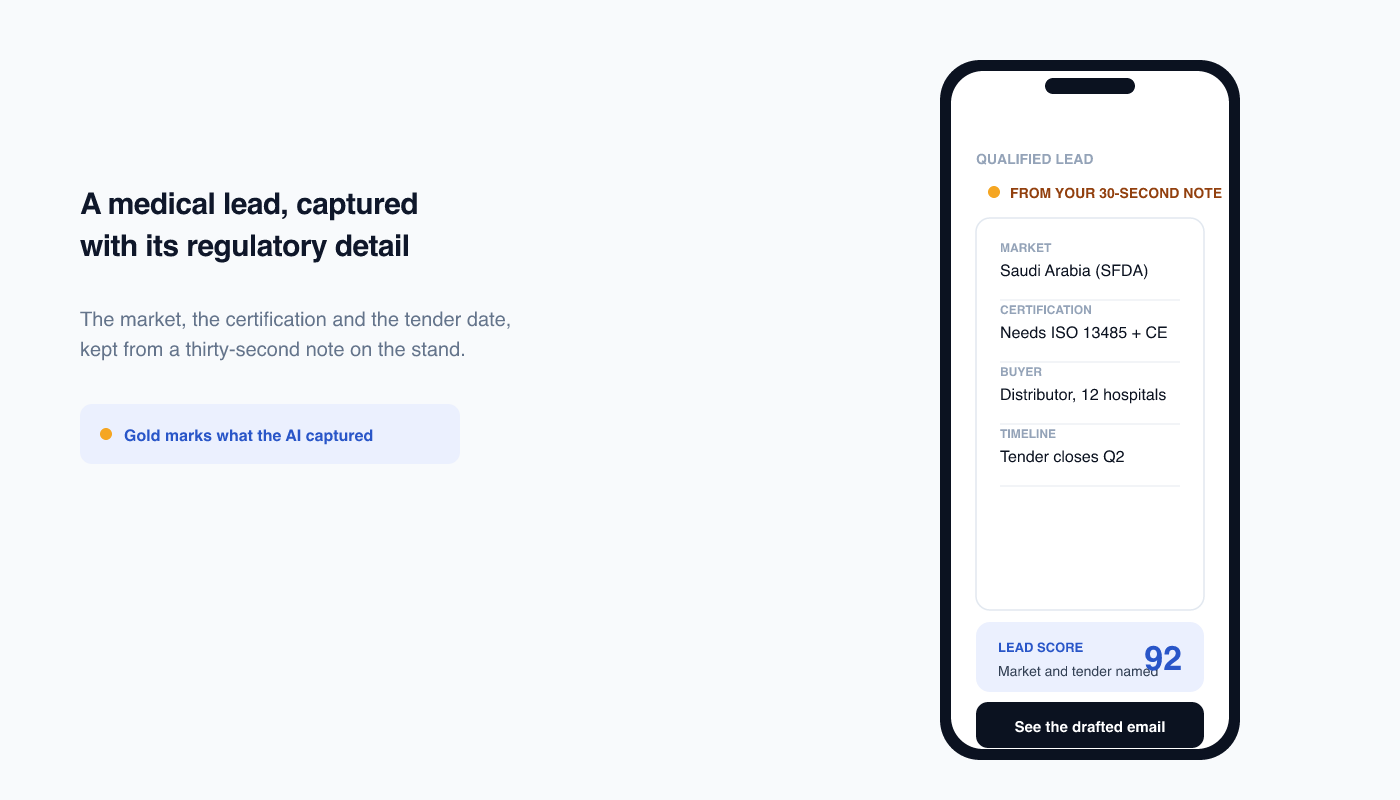
A badge scan gives you the contact. It does not tell you the distributor needed registration for Saudi Arabia, a valid CE mark, and a decision before a Q2 tender. That is the part that makes the lead high-value, and it is exactly the part a scan drops.
At a medical show, a lead's value is not how keen they were. It is whether you can legally sell to them, and when.
The official app is worth using to pre-book meetings with the right buyer types before the doors open. But it records who they are, not the regulatory requirement that defines the deal. That has to be captured in the conversation, while the rep still remembers which approval the buyer asked about.
![A medical lead captured with its regulatory detail intact]
MeetZaa does this on the stand. A thirty-second voice note becomes a structured lead with the market, the certification, the buyer type and the timeline captured, scored, and the follow-up drafted. Most Indian medical exhibitors come through the Pharmexcil pavilion, where everyone captures on paper, so doing it properly is a real edge.
Do the maths for a medical show. You may have forty serious conversations across four days, fewer than a consumer show but each worth far more. If you can recall the regulatory detail of only ten, the tenders and registrations hiding in the other thirty lapse, not because the buyers were wrong, but because the requirement was lost.
How to work Arab Health as a medical exhibitor
The plan for a high-value show is different from a high-volume one. You are not chasing footfall, you are qualifying fit.
- 1Know your own regulatory status per market before you go, so you can answer the first question honestly.
- 2Pre-book meetings through the official app with distributors and buyers in your target markets.
- 3Run the five-question checklist in every serious conversation.
- 4Capture the market, certification and timeline on the stand, not from memory afterwards.
- 5Follow up within 48 hours with the specific regulatory answer the buyer needs.
At Arab Health the winners are not the exhibitors with the most scans. They are the ones who left with a short list of regulatory-qualified buyers and the exact requirement of each, ready to act before the tender window closes.
Questions medical exhibitors ask about Arab Health
5When and where is Arab Health 2027?
It runs from 25 to 28 January 2027, now under its new name World Health Expo (WHX) Dubai. For the first time it spans two venues, the Dubai Exhibition Centre at Expo City and the Dubai World Trade Centre. Check which venue your product sector sits in before planning stand logistics and travel.
Is Arab Health the same as World Health Expo?
Yes. Informa Markets renamed Arab Health to World Health Expo (WHX) Dubai at its fiftieth edition in 2026. It is the same event, in the same slot in late January, with the same organiser and buyer base. Most exhibitors still search for it as Arab Health.
Who are the buyers at Arab Health?
Hospital and clinic procurement teams, regional distributors and importers, group purchasing organisations, and tender agents buying for public health systems. They are high-value, relationship-driven buyers, and many are sourcing for specific markets with specific regulatory requirements, which is what you need to qualify for.
What certifications do buyers ask about at a medical show?
Commonly a quality management standard such as ISO 13485 for devices, a CE mark for Europe, good manufacturing practice for pharma, and registration with the destination market's regulator, such as Saudi Arabia's SFDA or the UAE's MOHAP. Buyers filter on these before they discuss price, so capture which ones each buyer needs.
How do you qualify a medical trade show lead?
Establish regulatory fit first: which market they buy for, whether you are registered there, which certifications they require, their buyer type, and their volume and timeline. A buyer in a market you cannot yet sell into is a nurture contact, not a live deal. Capture these answers on the stand while the conversation is fresh.
Walk out of the show with every lead already moving
Scan the card, say what was discussed, and the follow-up is drafted before your rep reaches the next stand. Works offline.
Keep reading
Best Trade Show Lead Capture Apps in 2026
An honest comparison of Blinq, iCapture, Captello, Momencio, Cvent LeadCapture and MeetZaa — what each costs, who each suits, and where scanner rental still wins.
How to capture better leads at a trade show, not just more leads
More scans is not more pipeline. Here is the quality capture framework, the volume-versus-depth trade-off, and why capturing better beats capturing more.
WTM London hosted buyer meetings: winning the appointment show
WTM London runs on hosted-buyer appointments, not walk-ups. Here is the buyer-seller meeting funnel, where it leaks, and the two stages you actually control.