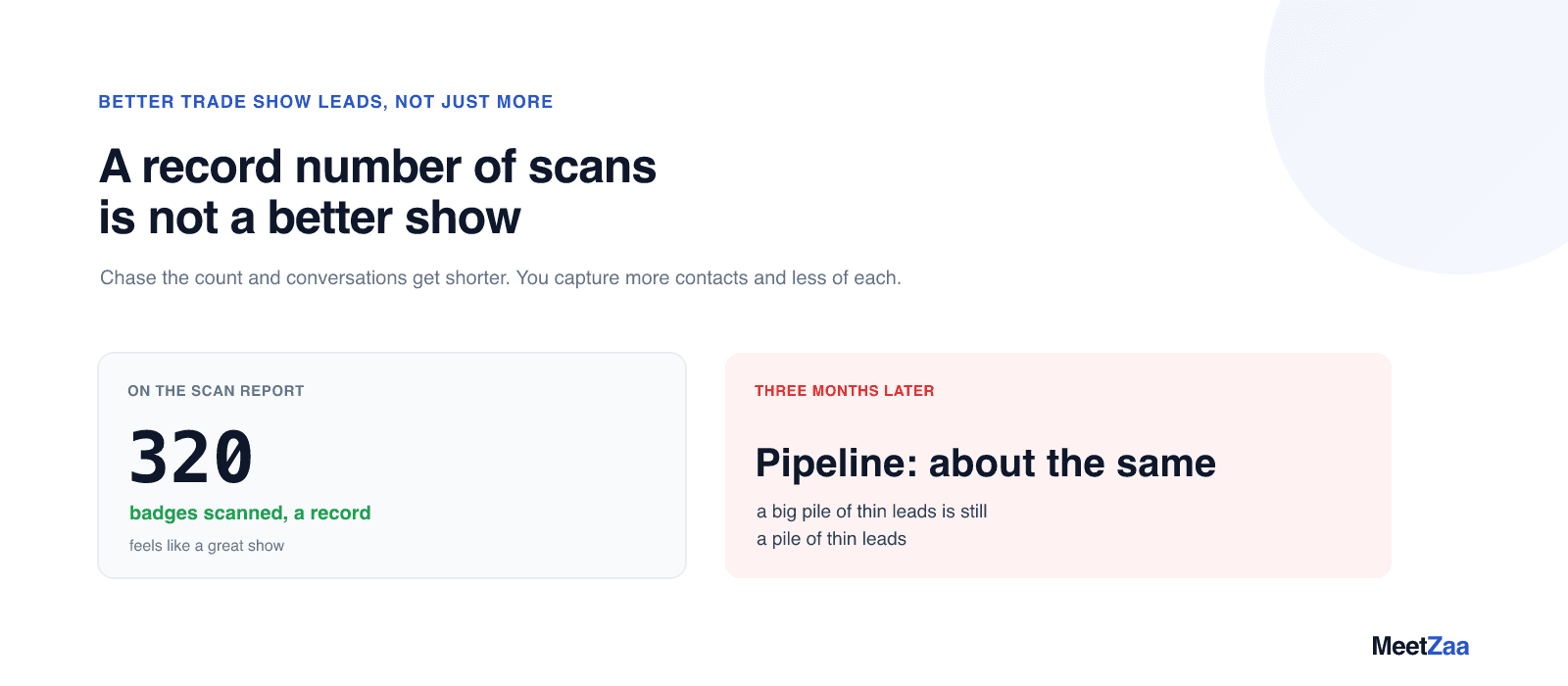
A sales manager sets the trade show target: scan three hundred badges. The team hits three hundred and twenty, a record, and everyone is pleased on the flight home. Three months later the pipeline from the show is no better than last year's, and a bit worse.
Here is why. When the target was the number of scans, every rep optimised for it. Conversations got shorter, because a long one costs you scans. The team captured more contacts than ever and less of each conversation than ever, and thin leads convert badly however many of them you have.
The instinct that more leads is a better show is wrong past a certain point. Beyond it, the thing that grows your pipeline is not more leads, it is better ones. This post is about the difference, and how to capture better without capturing fewer.
More is the wrong axis to chase
Think of every show as scoring on two axes. One is volume, how many leads you captured. The other is depth, how much of each conversation you actually kept. Most teams track only the first, because it is easy to count, and ignore the second, because it is not.
That is a problem, because depth is the axis that converts. A shallow lead, a name with no context, follows up generically and closes rarely, whether you have fifty or five hundred of them. A deep lead, captured with the need and the next step, follows up specifically and closes far more often.
So a show measured only on volume optimises the axis that matters least. Worse, chasing volume actively hurts depth, because the fastest way to scan more people is to talk to each one less. The target does not just miss quality. It quietly destroys it.
It is worth being fair to volume, because reach is not nothing. You do want to meet plenty of the right buyers, and a stand nobody visits captures nothing at all. But volume is a floor, not the goal. Once you talk to enough people, extra effort is better spent on depth than on a few more scans.
The quality capture framework
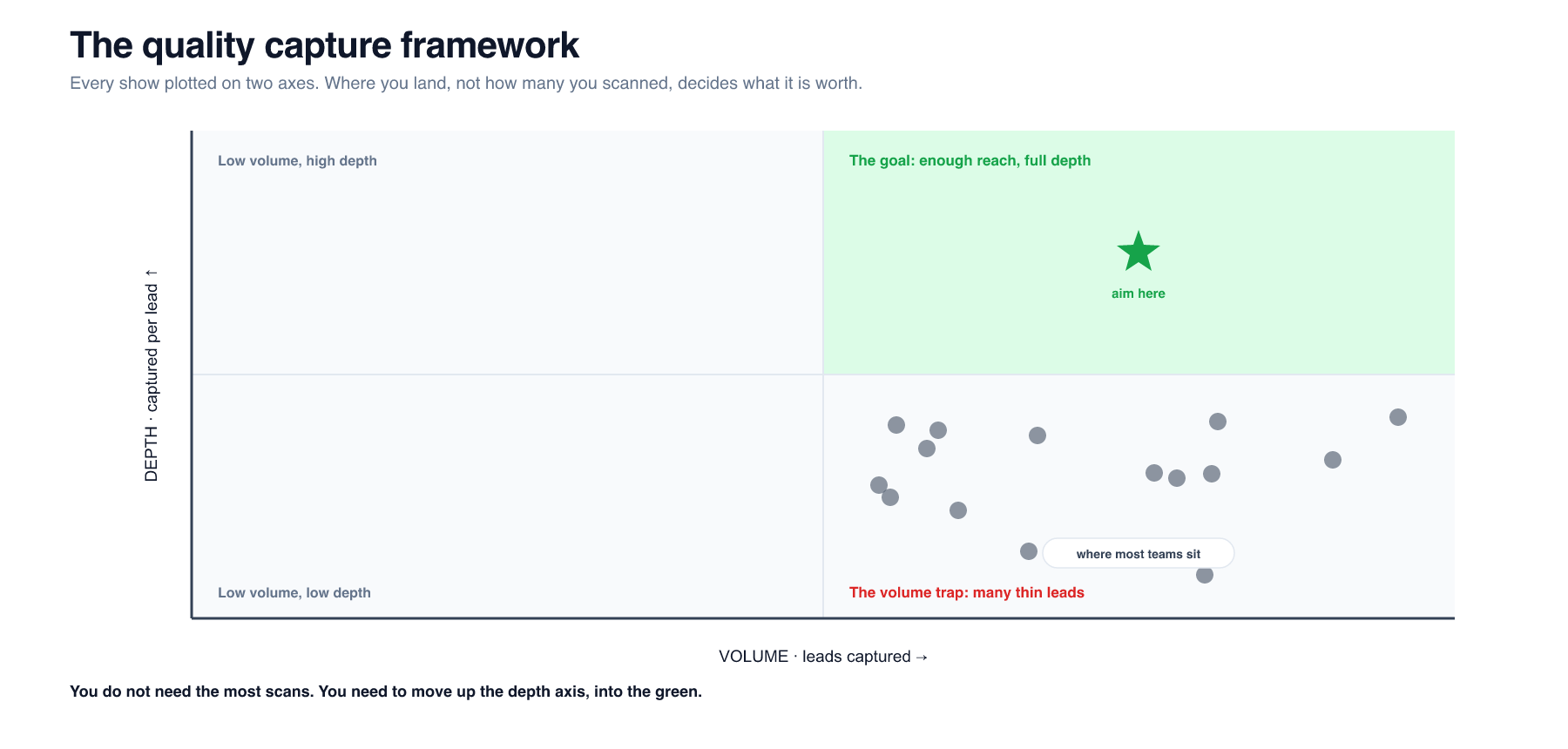
Here is the quality capture framework, every show plotted on those two axes, volume across the bottom and depth up the side. Where your stand lands decides what the show is worth.
![The quality capture framework: every show plotted on volume against depth]
Most teams sit in the bottom right, high volume and low depth. A lot of leads, almost none of them complete. It looks like a great show on the scan report and produces a quiet quarter, because a big pile of thin leads is still a pile of thin leads.
The goal is the top right, enough volume and high depth. Not the most scans, but the most complete leads. That is the corner where a show actually pays, and reaching it is about capturing better, not scanning more.
The four places a stand can land
There are four corners, and it is worth knowing which one you are in.
| Where you land | What it looks like | What to do |
|---|---|---|
| Low volume, low depth | Few leads, all thin | Fix capture first, then reach |
| High volume, low depth | Many leads, all thin | The volume trap: add depth, not scans |
| Low volume, high depth | Few leads, but complete | Good habits, now widen the net |
| High volume, high depth | Many complete leads | The goal: keep it up |
Almost every team that feels busy but sees weak returns is in the high-volume, low-depth corner, the volume trap. The fix is not to scan less. It is to capture more of each conversation, so the leads you already get become the leads you can actually work.
You do not have to choose
The reason teams treat this as a trade-off is that, by hand, it is one. Capturing depth takes time, time takes conversations, so more depth means fewer leads. If capture is slow, volume and depth really do fight.
Fast capture ends the trade-off. This is what MeetZaa is for: a thirty-second voice note per conversation captures the full depth, the need, the timeline, the next step, without costing you the length of the conversation or the next visitor. Depth stops being expensive.
![Pipeline is volume times depth: a busy shallow show against a deep one]
So you can sit in the top-right corner, high volume and high depth, because capturing a complete lead no longer takes longer than scanning a thin one. MeetZaa makes better and more the same choice, instead of opposite ones.
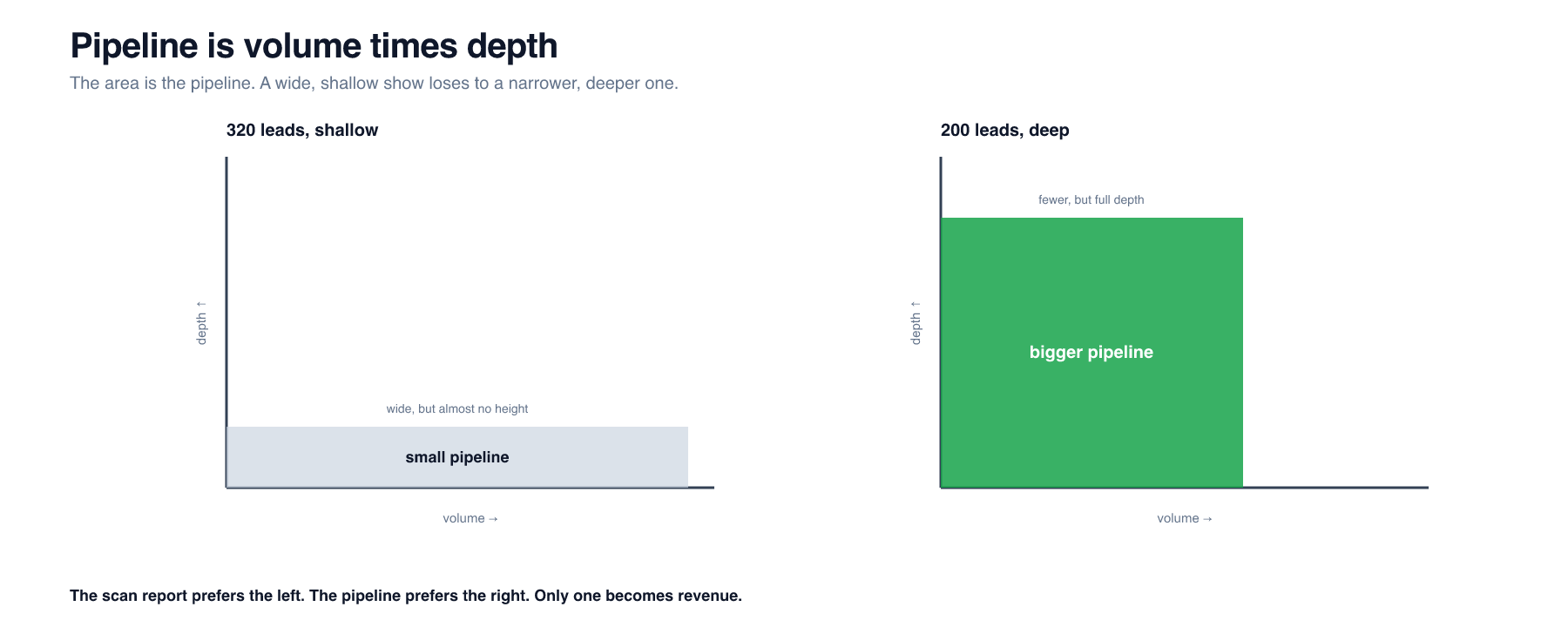
Do the maths as an area, because pipeline is roughly volume times depth. Three hundred leads captured at a tenth of their depth is not thirty leads' worth of pipeline, it is often less, because a name with no context barely converts at all.
Two hundred leads captured in full can outproduce all three hundred, from a less busy show. The scan report will always prefer the three hundred. The pipeline will prefer the two hundred. Only one of those two numbers turns into revenue.
How to capture better, not just more
Capturing better is mostly about changing what you measure and how you capture.
- 1Drop the scan count as your target, and measure complete leads instead.
- 2Judge the show on depth: how many leads have the need and the next step.
- 3Do not shorten conversations to chase numbers, because depth is where the value is.
- 4Capture the full conversation fast, so depth costs you nothing in volume.
- 5Aim for the top-right corner, enough reach and full depth, not the most scans.
A record number of scans feels like a great show and rarely is one. The shows that pay are the ones where the leads came home complete, not just numerous.
Stop chasing the axis that is easy to count, capture the one that converts, and with fast capture you do not have to give up either. That is what better leads means, and it is what MeetZaa is built to make routine.
Questions about capturing better trade show leads
5How do you capture better leads at a trade show?
Capture more of each conversation, not more conversations. A better lead has the context that makes it workable: the need, the timeline, who decides and the next step. Measure the show on how many leads have those, not on how many badges were scanned, and capture fast enough that depth does not cost you reach.
Are more trade show leads always better?
No. Past a point, more leads only helps if they are captured well, because a thin lead converts poorly whether you have fifty or five hundred. Chasing volume often lowers quality, since the fastest way to scan more people is to talk to each one less. Pipeline comes from depth, not from the raw count.
What is lead quality at a trade show?
It is how completely a lead is captured and how well it is qualified. A high-quality lead carries the conversation, what the person needs, their timeline, their authority and the agreed next step, so it can be prioritised and followed up specifically. A low-quality lead is a bare contact that all looks the same and follows up generically.
Why do high scan counts not lead to more sales?
Because a scan captures a contact, not a conversation, so a high scan count is a large pile of thin leads. Thin leads follow up generically and convert like a cold list, so multiplying them multiplies the noise, not the pipeline. Sales grow when the leads are deep enough to act on, which the scan count does not measure.
How do you measure trade show lead quality?
Count the leads that are complete and actionable, not the ones that exist. A simple measure is the share of leads that have a recorded need and a next step, because those are the ones a salesperson can actually work. Track that number show to show, and you are optimising depth instead of volume.
Walk out of the show with every lead already moving
Scan the card, say what was discussed, and the follow-up is drafted before your rep reaches the next stand. Works offline.
Keep reading
Best Trade Show Lead Capture Apps in 2026
An honest comparison of Blinq, iCapture, Captello, Momencio, Cvent LeadCapture and MeetZaa — what each costs, who each suits, and where scanner rental still wins.
Arab Health exhibitor guide: capturing high-value medical leads
An Arab Health exhibitor guide for 2027, now World Health Expo Dubai, with the dates, a regulatory-buyer checklist, and how to capture high-value leads.
WTM London hosted buyer meetings: winning the appointment show
WTM London runs on hosted-buyer appointments, not walk-ups. Here is the buyer-seller meeting funnel, where it leaks, and the two stages you actually control.