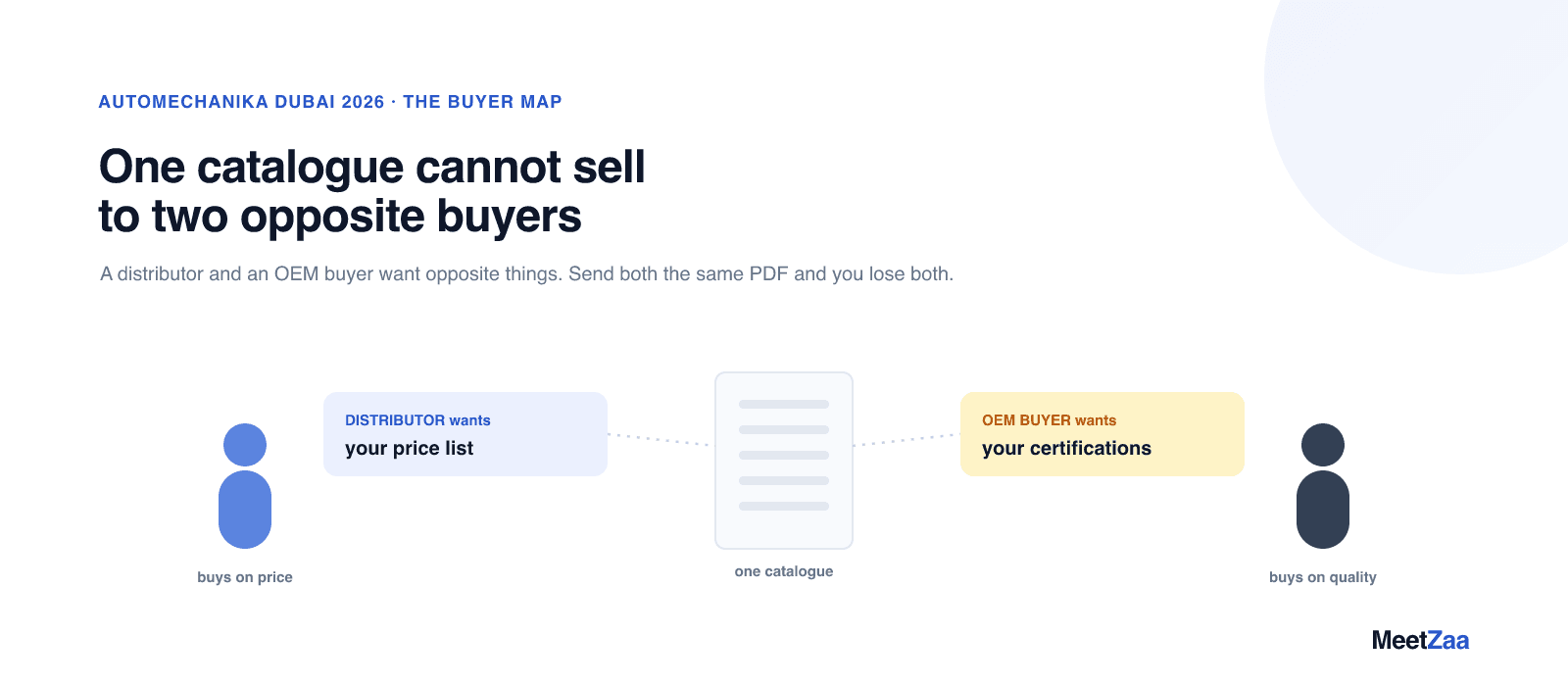
On the Monday after Automechanika Dubai, an auto-component exporter sends the same PDF catalogue to all eighty leads from the show. It is a good catalogue. It is also the wrong follow-up for almost everyone who gets it.
The regional distributor who spent ten minutes at the stand wanted a price list, a minimum order quantity and a lead time, so they could work out their margin. They get a catalogue with no prices and delete it.
The OEM sourcing manager wanted your quality certifications and your capacity, to see if you could ever be qualified. They get the same catalogue, and conclude you did not understand what they asked.
Both were real opportunities. Both are gone, not because the products were wrong, but because the follow-up treated a distributor and an OEM buyer as the same person. At Automechanika they are not, and telling them apart is most of the job.
Automechanika Dubai has moved for 2026
First, the thing every returning exhibitor needs to know. Automechanika Dubai 2026 runs from 10 to 12 November, and it has moved. After twenty-two editions at Dubai World Trade Centre, the show is now at the Dubai Exhibition Centre in Expo City Dubai, organised by Messe Frankfurt.
The move matters for planning. A new venue means new hall layouts, new contractor accreditation and new logistics for your stand and your samples, so do not assume last year's plan carries over. Check your hall and your build details early.
expected at Automechanika Dubai across the Middle East, Africa and beyond, spanning very different kinds of buyer
The show is the largest automotive aftermarket platform in the region, with more than 1,500 exhibitors and eleven product sections, from parts and components to electronics, tyres and batteries, repair and maintenance, and car care. For an exporter, that scale is the opportunity and the trap: a lot of buyers, of a lot of different kinds.
Your buyers are not one kind of buyer
Walk your leads back and they fall into very different groups. A distributor buys volume to resell across a territory. An OEM or original-equipment buyer wants a qualified supplier for a production line. A workshop chain or fleet operator buys to use. A retailer or online seller buys to shelve. Each of them decides to buy on a different thing.
This is why one pitch and one follow-up cannot work. The distributor is buying on price, range and reliability of supply. The OEM buyer is buying on quality systems, certifications and capacity, and will not care about your shelf price. Say the wrong thing to either, and you have confirmed you are not their kind of supplier.
A distributor and an OEM buyer can hand you the same business card and want opposite things. Sell them the same way and you lose both.
The distributor-to-OEM buyer map
Here is the distributor-to-OEM buyer map, the buyer types you meet at Automechanika laid out from the volume-reselling end to the production-line end, with what each buys on and what winning them looks like.
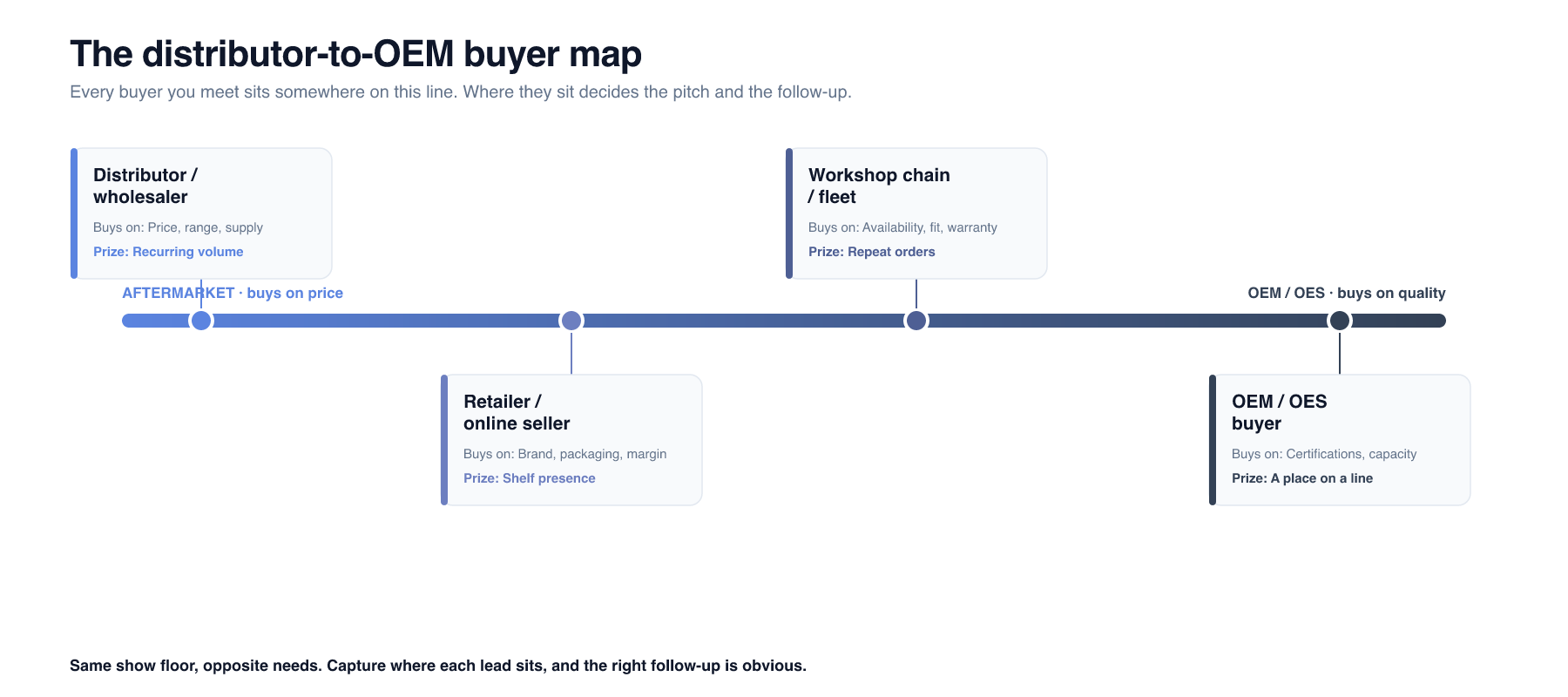
| Buyer type | What they buy on | Sales cycle | The prize for an exporter |
|---|---|---|---|
| Distributor / wholesaler | Price, range, supply reliability | Medium | Recurring regional volume |
| Retailer / online seller | Brand, packaging, margin | Short to medium | Shelf and listing presence |
| Workshop chain / fleet | Availability, fit, warranty | Short | Steady repeat orders |
| OEM / OES buyer | Quality systems, certifications, capacity | Long | A qualified place on a line |
Read across the map and the follow-up writes itself. A distributor needs your price list and terms. An OEM buyer needs your certifications and capacity. A workshop chain needs availability and fit.
The map is only useful, though, if you know which row each lead belongs to, and that is decided at the stand, in the conversation, not on the badge.
What a scan cannot capture
The official show app will scan a badge and give you a name, a company and a country. It will not tell you whether that company is a distributor buying on price or an OEM buying on certifications. That distinction, the one that decides your entire follow-up, lives in the conversation.
This is where MeetZaa fits an exporter's show. After each conversation the rep records a thirty-second voice note, and it becomes a structured lead: the buyer type, what they buy on, the products and volumes they asked about, and the next step, with the follow-up drafted to match.
So the distributor gets a price list and a minimum order quantity, the OEM buyer gets your certifications and capacity, and the workshop chain gets availability, each within a day of the show. MeetZaa turns one conversation into the right follow-up, instead of one catalogue into eighty wrong ones.
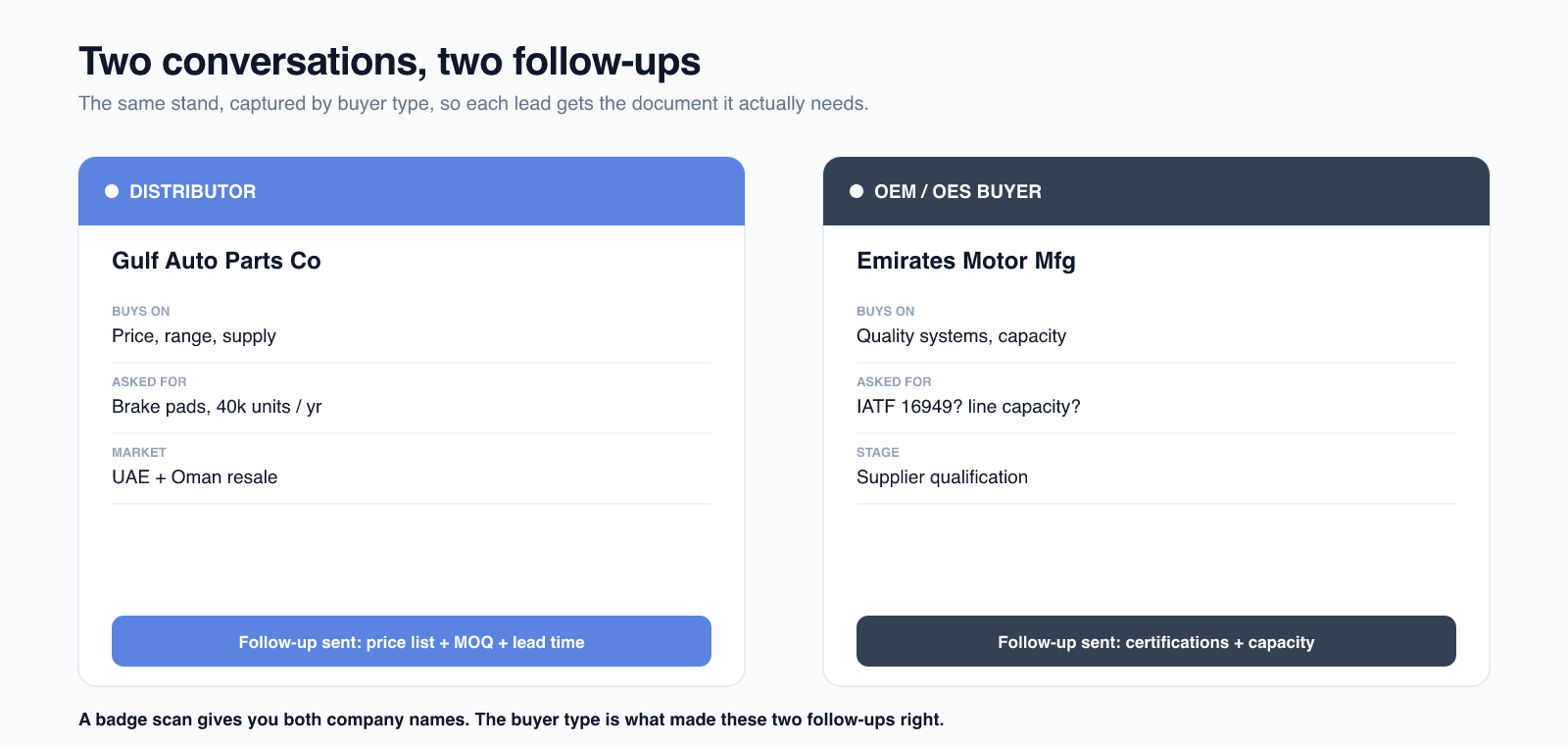
Do the maths on an export stand. Say your team has eighty real conversations, split across distributors, OEM buyers, workshops and retailers. Send one generic catalogue and you match maybe a fifth of them by luck. Capture the buyer type and let MeetZaa draft four tailored follow-ups, and you match all eighty, from the same eighty conversations.
The cost of the show did not change. What changed is how many of the leads you paid for got a follow-up they could act on.
How to work Automechanika Dubai
Working an export show well is about sorting the buyer types and capturing what each one buys on.
- 1Check your new hall and stand details early, because the show has moved to Expo City for 2026.
- 2Ask each visitor what they do with the product: distribute it, build with it, fit it, or shelve it.
- 3Capture what they buy on, price and terms for a distributor, certifications and capacity for an OEM buyer.
- 4Note the specifics, the products, volumes and markets they asked about, so the follow-up is concrete.
- 5Follow up within 48 hours with the document that buyer type needs, not a single catalogue for all.
Automechanika Dubai brings the region's aftermarket buyers to one floor, and moves to a new home in Expo City for 2026. The exhibitors who win it remember that a distributor and an OEM buyer want opposite things.
Sort the two at the stand, and follow up each with what they actually asked for. Do that, and eighty conversations become eighty leads, not one catalogue sent eighty times.
Questions exhibitors ask about Automechanika Dubai
5When and where is Automechanika Dubai 2026?
Automechanika Dubai 2026 runs from 10 to 12 November 2026, and it has moved to the Dubai Exhibition Centre at Expo City Dubai after twenty-two editions at Dubai World Trade Centre. Organised by Messe Frankfurt, it is the region's largest automotive aftermarket show, with more than 1,500 exhibitors and 30,000-plus trade buyers across eleven product sections.
Who are the buyers at Automechanika Dubai?
Several different kinds. Distributors and wholesalers buying volume to resell, OEM and original-equipment buyers looking for qualified suppliers, workshop chains and fleet operators buying to use, and retailers and online sellers buying to shelve. They can hand over similar business cards but decide to buy on very different things, which is why sorting them matters.
What is the difference between a distributor and an OEM buyer?
A distributor buys volume to resell across a territory and decides on price, range and reliable supply. An OEM or original-equipment buyer wants a qualified supplier for a production line and decides on quality systems, certifications and capacity, not shelf price. The two need completely different pitches and follow-ups, so pitching them the same way loses both.
How should an exporter follow up Automechanika leads?
By buyer type. Send a distributor your price list, terms and minimum order quantity; send an OEM buyer your certifications and capacity; send a workshop chain availability and fit. A single catalogue to everyone fails, because it has no prices for the distributor and no certifications for the OEM buyer. Capture the buyer type at the stand so the follow-up can match.
What should you capture at an Automechanika stand?
More than the badge. Capture what the visitor does with your product, what they buy on, and the products, volumes and markets they asked about. That decides which follow-up they need, and none of it is on the badge, so it has to come from the conversation and be recorded before it fades.
Walk out of the show with every lead already moving
Scan the card, say what was discussed, and the follow-up is drafted before your rep reaches the next stand. Works offline.
Keep reading
Best Trade Show Lead Capture Apps in 2026
An honest comparison of Blinq, iCapture, Captello, Momencio, Cvent LeadCapture and MeetZaa — what each costs, who each suits, and where scanner rental still wins.
Arab Health exhibitor guide: capturing high-value medical leads
An Arab Health exhibitor guide for 2027, now World Health Expo Dubai, with the dates, a regulatory-buyer checklist, and how to capture high-value leads.
How to capture better leads at a trade show, not just more leads
More scans is not more pipeline. Here is the quality capture framework, the volume-versus-depth trade-off, and why capturing better beats capturing more.