One pager puide for your decision makers
The trade show budget is the easiest line to cut, and your CFO has probably already circled it. Not because they believe the shows do nothing, but because it is the line they can least defend with numbers, and a budget you cannot defend with numbers is the first to go when money is tight.
You get one meeting to change that, and you should not walk in with a recap deck. A deck of photos, footfall and badge scans tells a CFO that you were busy, not that the money came back. To them it reads as activity in search of a justification, and it confirms the instinct to cut.
What changes their mind is one page, in their language, that shows what the shows cost and what they returned. This post is how to build it, and why you can only build it if you captured the right things at the show in the first place.
Why the trade show budget gets cut first
Start by understanding the cut, because it is rational. A CFO allocates money to the lines that can show a return, and starves the ones that cannot. The trade show line often cannot, and that is a reporting problem, not proof that the shows failed.
The show may well have produced pipeline and revenue. But if all that came back was a folder of scans and a note that footfall was up, the return is invisible on the finance side. The CFO is not cutting the results. They are cutting a line that never showed them any.
So the job is not to argue that shows are valuable in general. Every marketer says that, and every CFO has heard it. The job is to show this show, in money, the way every other line in the budget is shown.
Speak the CFO's language, not marketing's
Most trade show reporting is written in marketing language, and a CFO does not buy in that language. The fix is a straight translation, from the metrics you tend to report to the ones the finance team actually recognises.
| What you report now | What the CFO hears | What to put in front of them instead |
|---|---|---|
| Footfall and stand visits | Activity, not money | Cost of the show against the pipeline it created |
| Badge scans or leads | An unverified list | Qualified leads, and how many became opportunities |
| Brand impressions | A number with no price | Revenue and pipeline attributable to the show |
| "It was a great show" | A feeling | Payback, revenue returned per unit of spend |
Read the right-hand column and notice what it needs. Every one of those answers requires you to know how many leads were qualified, which became opportunities, and which closed. That is not a reporting skill. It is a capture and tracking one, and it starts at the stand.
The CFO one-pager
Here is the CFO one-pager, the whole case on a single page, in the order a CFO reads it. It replaces the recap deck entirely, and it has just five lines.
[The CFO one-pager: the trade show budget case in five finance lines]
The order matters. It opens with the cost, because that is the number the CFO already has in mind, and it shows you are not hiding from it. Then it moves through qualified leads to opportunities to closed revenue and open pipeline, ending on payback, the single figure that decides whether the line survives.
Every number on the page is one a CFO can check and would use for any other investment. There is no footfall, no impressions and no adjectives, because none of those survive contact with a finance review.
You can only fill it if you captured the leads
The one-pager has an uncomfortable requirement. You cannot write it from a folder of badge scans, because a scan does not tell you whether a lead was qualified, or what happened to it. To fill the page you need to have captured, at the show, the things that let you track a lead to revenue.
That means, for each conversation, what the buyer needed, whether they were qualified, and the next step, captured well enough that the lead can be followed and its outcome recorded. A badge and a business card cannot do that. The conversation can, if you capture it.
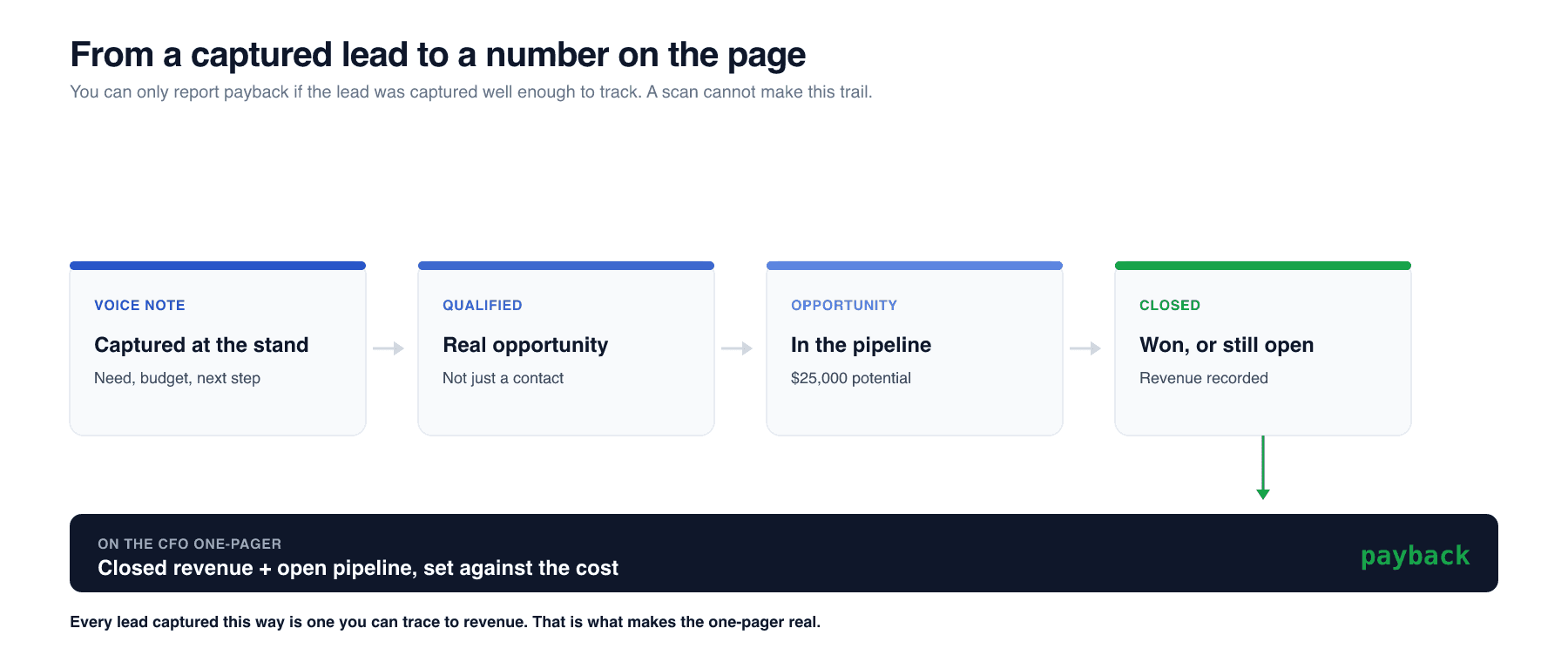
This is where MeetZaa earns its place in the budget conversation. Because each lead is captured as a structured record, with the need, the qualification and the next step, the leads can be tracked from the stand to the opportunity to the closed deal.
With MeetZaa, the one-pager writes itself from data you already have. Instead of defending a feeling, you hand the CFO a page built from tracked leads, and the burden shifts. The question stops being whether the shows are worth it, and becomes which shows returned the most, which is a planning conversation, not a cutting one.
[From a captured lead to a line on the one-pager: how the trail is built]
Do the maths the way the CFO will. Say the year's shows cost $60,000, fully loaded, and produced forty qualified leads, of which eight became opportunities worth $200,000 in total, and three have closed for $70,000 so far. The payback line already reads better than one to one on closed revenue alone, before the open pipeline.
That is a case. It survives a finance review because every number is real and traceable. The recap deck version, $60,000 for lots of scans and good footfall, does not survive the first question.
How to justify the trade show budget
Justifying the budget is mostly about arriving with the right page, built from the right data.
- 1Report the full cost of each show, not just the space, so the CFO trusts the numbers.
- 2Track qualified leads, not scans, from the stand through to opportunities and closed revenue.
- 3Put the case on one page, in finance language, ending on payback.
- 4Show it per show, so the conversation becomes which shows to keep, not whether to exhibit.
- 5Bring it before the budget is drafted, not after the line has been cut.
A trade show budget does not get cut because shows do not work. It gets cut because it arrives at the finance review with no case.
Give the CFO one page in their own language, backed by leads you actually captured and tracked, and the line that was first to go becomes the one you defend on the numbers. That page, and the capture behind it, is what MeetZaa is built to give you.
Questions marketers ask about justifying a trade show budget
5How do you justify a trade show budget to a CFO?
With one page in finance language, not a recap deck. Show the full cost of the shows, the number of qualified leads, how many became opportunities and their value, the closed revenue and open pipeline, and the payback. A CFO cuts lines that cannot show a return, so the job is to show this show in money, the way every other budget line is shown.
Why is the trade show budget usually the first to be cut?
Because it is often the hardest to defend with numbers, not because shows fail. If all that comes back from a show is footfall and badge scans, the return is invisible to finance, so the line looks like cost with no measurable result. That is a reporting and capture problem, and it is fixable.
What should a trade show ROI one-pager include?
Five lines: the fully-loaded cost of the shows, the qualified leads captured, the opportunities created and their value, the closed revenue and open pipeline, and the payback set against the cost. No footfall, no impressions and no adjectives, because those do not survive a finance review. Every number should be one the CFO can check.
How do you measure trade show ROI for finance?
Track leads, not scans, from the stand to revenue. That means capturing, for each conversation, whether the lead was qualified and what the next step was, so it can be followed to an opportunity and a closed deal. ROI is then closed revenue and open pipeline set against the fully-loaded cost of the show.
What metrics do CFOs care about for events?
Cost, pipeline, revenue and payback, the same metrics they apply to any investment. They do not buy footfall, brand impressions or "it was a great show," because none of those have a price attached. Translate your event results into those four finance metrics and the budget conversation changes entirely.
Walk out of the show with every lead already moving
Scan the card, say what was discussed, and the follow-up is drafted before your rep reaches the next stand. Works offline.
Keep reading
Best Trade Show Lead Capture Apps in 2026
An honest comparison of Blinq, iCapture, Captello, Momencio, Cvent LeadCapture and MeetZaa — what each costs, who each suits, and where scanner rental still wins.
Arab Health exhibitor guide: capturing high-value medical leads
An Arab Health exhibitor guide for 2027, now World Health Expo Dubai, with the dates, a regulatory-buyer checklist, and how to capture high-value leads.
How to capture better leads at a trade show, not just more leads
More scans is not more pipeline. Here is the quality capture framework, the volume-versus-depth trade-off, and why capturing better beats capturing more.