It is the end of the second day, and you open the lead list your team captured. Sixty entries, and forty of them say some version of the same thing, "interested, send info." A handful have a name and nothing else.
You were there for some of those conversations, and you know they were better than three words. The three words are all that survived.
This is not a discipline problem, and it is not a bad team. It is a bandwidth problem. Between one conversation and the next, a rep at a busy stand has seconds, not minutes, and typing a real note into a phone takes longer than that.
So the note gets compressed to whatever fits in the gap, which is almost nothing.
The question this post asks is simple. Given the few seconds a rep actually has, how do you capture the most of the conversation? The answer turns out to be less about discipline and more about method, because voice and typing are not equally fast, and the difference decides what survives.
The real constraint is the gap, not the rep
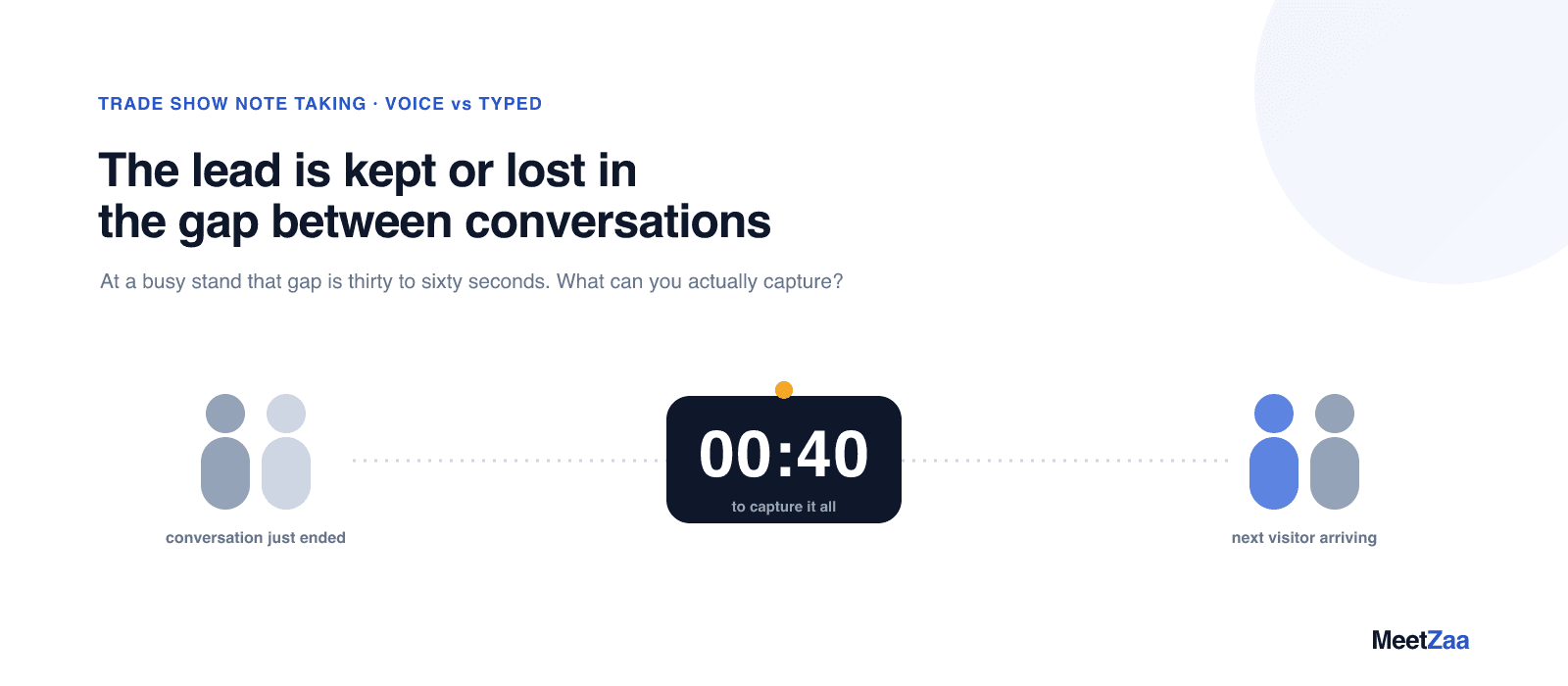
The rhythm of a good show is back to back. A conversation ends, and the next visitor is already waiting or walking up.
The gap between the two is where the note has to happen, and at a busy stand that gap is often thirty to sixty seconds, not the quiet few minutes it would take to type a proper record.
In that gap the rep has three choices. Capture nothing and trust memory, type a few words into a form, or say what happened out loud. Each fits a different amount of the conversation into the same few seconds, and that is the whole game.
Memory feels free, but it is the most expensive option. By Monday the twenty-minute conversation has faded to a name and a vague good feeling, and the details that made the lead worth following up are gone. What you did not record, you did not keep.
What a rep actually captures
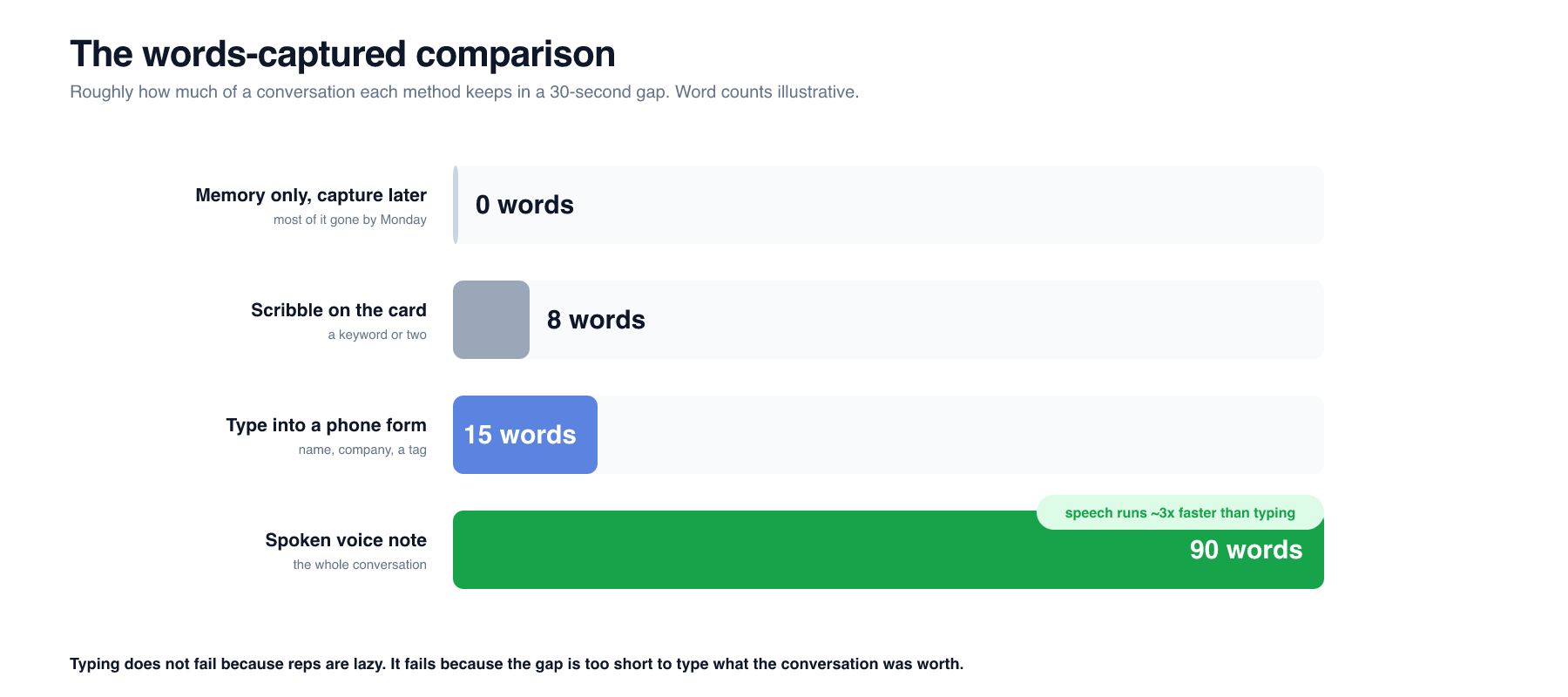
Here is the words-captured comparison, roughly how much of a conversation each method preserves in the thirty seconds a rep realistically has between visitors. The word counts are illustrative, but the order is not, and it follows directly from how fast each method is.
![The words-captured comparison: how much of a conversation survives each method in a 30-second gap]
| Capture method | Words in a 30-second gap | What survives | What is lost |
|---|---|---|---|
| Memory only, capture later | 0 at the stand | a name, if the badge was scanned | most of it, by Monday |
| Scribble on the card | around 8 | a keyword or two | almost everything said |
| Type into a phone form | around 15 | name, company, a tag | the needs, the specifics, the next step |
| Spoken voice note | around 90 | the whole conversation | little, if you record it at once |
speech input on a phone runs about three times faster than typing, 161 words a minute against 53 in a Stanford study
Read the table and the reason is plain. In the same half-minute, speaking captures several times what typing does, because the mouth is faster than the thumbs. Typing does not fail because reps are lazy. It fails because there is not enough time to type what the conversation was actually worth.
Why typing loses at a stand
Typed capture works well in a quiet room with ten leads. At a stand with two hundred conversations over four days it quietly breaks, and it breaks in a way nobody notices until the follow-up.
The break is silent. A rep who cannot type the full note in the gap does not stop and hold up the queue. They type the fastest thing that feels like something, "interested, send pricing," and move on.
The record looks complete in the list. It is only when you sit down to follow up that you find sixty variations of nothing.
Voice removes the constraint that causes this. A rep can say ninety words in the time it takes to type fifteen, so the note holds the need, the timeline, the specifics and the next step, not just a tag. The gap stops being the thing that compresses the lead.
Voice captures what typing drops
There is a second difference, beyond speed. Typing forces the rep to decide, in the moment, what is worth the effort of typing, so they keep the obvious fields and drop the nuance. Speaking has no such tax. The rep just says what happened, including the offhand detail that turns out to matter.
This is what MeetZaa is built on. In the gap between conversations the rep records a thirty-second voice note, and it becomes a structured lead: the company, what they needed, the specifics they asked about, and the next step, with the follow-up drafted.
Because the rep spoke instead of typed, the lead holds the whole conversation, not the part that fit. MeetZaa turns the ninety spoken words into the fields a typed form would have left blank, so the follow-up is specific instead of generic.
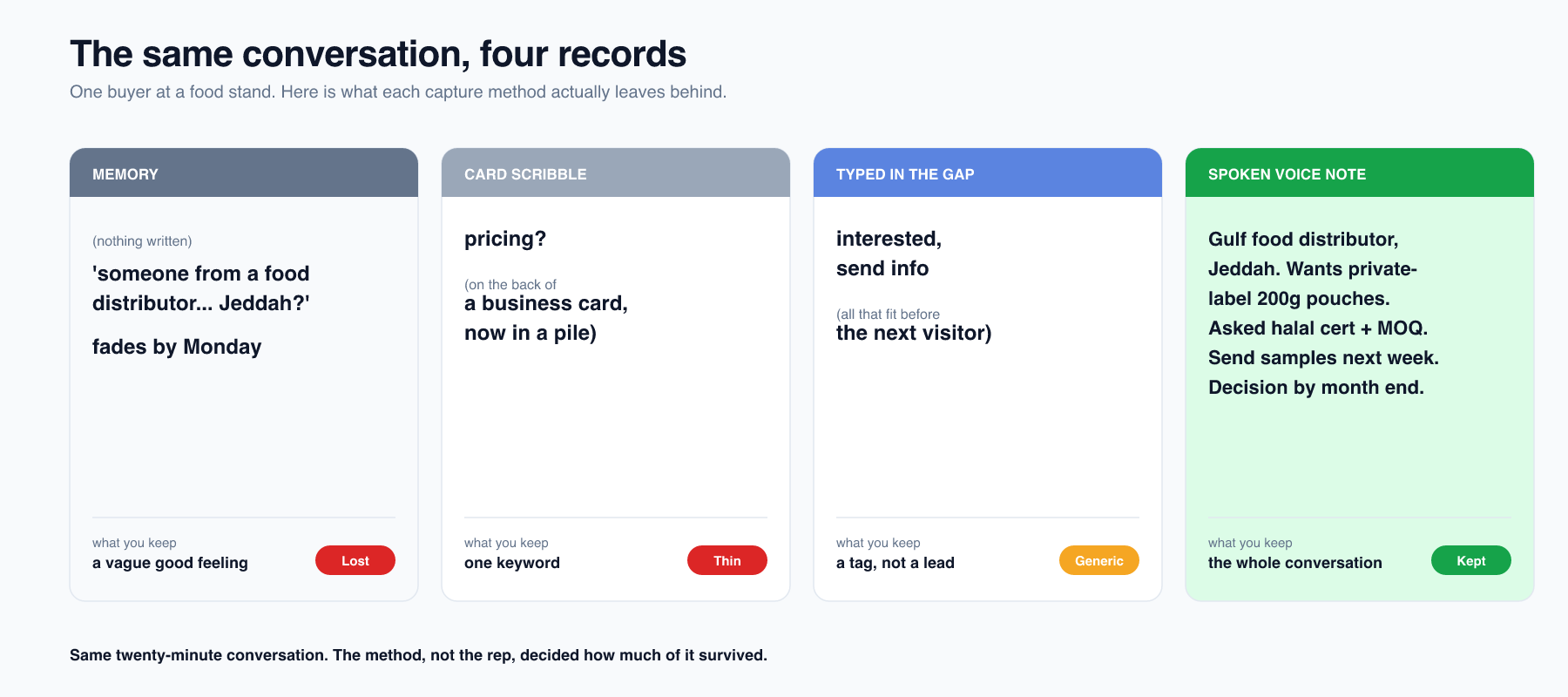
![The same conversation, four records: what each capture method actually leaves behind]
Do the maths across a four-day show. Say a rep has two hundred conversations. Typed, each note holds perhaps fifteen words, so the follow-up is generic and most leads go cold. Spoken, each holds around ninety, enough for MeetZaa to draft a follow-up that names what the buyer actually asked about.
The number of conversations is the same either way. What changes is how much of each one you still have on Monday, and that is the difference between two hundred contacts and two hundred leads.
How to capture more at your next show
Capturing more is mostly about matching the method to the few seconds you actually have.
- 1Assume seconds, not minutes. Plan capture around a thirty-second gap, because that is the real one.
- 2Capture by voice, not by thumbs, so the note holds the conversation and not just a tag.
- 3Record in the gap, right after each conversation, while the detail is fresh, not hours later.
- 4Capture the specifics, the need, the timeline and the next step, not only the name.
- 5Judge capture by what the entries say, not by how full the list looks.
A trade show is a few days of conversations you paid a lot to have. What you keep of them is decided in the seconds between one and the next, and in those seconds speaking beats typing every time. Capture by voice, and you go home with the conversations, not sixty leads that all say the same three words.
Questions reps ask about trade show note taking
5Are voice notes better than typed notes at trade shows?
For capturing at a busy stand, yes. The constraint is time between conversations, often thirty seconds or less, and speech input runs about three times faster than typing on a phone. In that gap a rep can say around ninety words but type only around fifteen, so a voice note holds the whole conversation while a typed note holds a tag. Typed notes are fine when you have time and few leads.
How do you take good notes at a trade show?
Match the method to the seconds you actually have. Capture right after each conversation, not hours later, and record the specifics, the need, the timeline and the next step, not just the name. Because typing is slow, the fastest way to hold the full conversation is to say it out loud as a short voice note.
Why do trade show leads end up so thin?
Because typing loses to the queue. A rep who cannot type a full note before the next visitor arrives types the fastest thing that feels like something, such as "interested, send info," and moves on. The list looks full, but each entry is the few words that fit the gap, which is why follow-up so often has nothing to work with.
How much can a rep actually capture between conversations?
In a realistic thirty-second gap, speaking captures several times more than typing. At around 161 words a minute spoken against 53 typed in a Stanford study, that is roughly ninety spoken words against fifteen or so typed under stand conditions. Handwriting on a card is slower still, so it usually leaves only a keyword or two.
Should reps write notes on the back of business cards?
It is better than nothing, but it is the slowest method, so it captures the least, usually a keyword. Cards also get separated from the note and piled up for later, when the conversation has already faded. A spoken note, captured in the moment and attached to the lead, holds far more and does not get lost.
Walk out of the show with every lead already moving
Scan the card, say what was discussed, and the follow-up is drafted before your rep reaches the next stand. Works offline.
Keep reading
Best Trade Show Lead Capture Apps in 2026
An honest comparison of Blinq, iCapture, Captello, Momencio, Cvent LeadCapture and MeetZaa — what each costs, who each suits, and where scanner rental still wins.
Arab Health exhibitor guide: capturing high-value medical leads
An Arab Health exhibitor guide for 2027, now World Health Expo Dubai, with the dates, a regulatory-buyer checklist, and how to capture high-value leads.
How to capture better leads at a trade show, not just more leads
More scans is not more pipeline. Here is the quality capture framework, the volume-versus-depth trade-off, and why capturing better beats capturing more.