It is Monday morning. On the desk is a rubber-banded stack of two hundred business cards, brought back from four days on a stand in Dubai. Somewhere in that stack are three orders. The rest is noise, and right now they all look exactly the same.
By Wednesday the stack has become a paperweight. The team is back on quotes and dispatches, the memory of each conversation is fading, and the cards will sit there until someone feels guilty enough to "get to them." Most never get gone through at all.
The stack is not the win. What you do with it in the next few hours is. Here is a triage that turns two hundred cards into a short list of orders to chase, before the memory goes cold.
Why the stack goes cold
A business card is a name, a company and an email. It is not what the person said. Standing at the stand you knew exactly who was serious, but a card does not record that, so by Monday a ready buyer and a brochure-collector are identical rectangles of paper.
That is where the leak starts. The often-quoted figure, widely attributed to the Center for Exhibition Industry Research, is that around 80 percent of trade show leads are never followed up. It does not begin with laziness. It begins with a stack nobody can tell apart, on a week when the real work has resumed.
It gets worse with volume. Ten cards you can just about hold in your head. Two hundred, gathered by four reps across four days, is beyond anyone's memory by the time the plane lands. The card that mattered is somewhere in the middle, indistinguishable from the forty you took out of politeness.
So the job on Monday is not to "follow up the leads." It is to sort them fast, while you still remember which was which, and to spend your best hours on the few that will actually order.
The Monday Triage
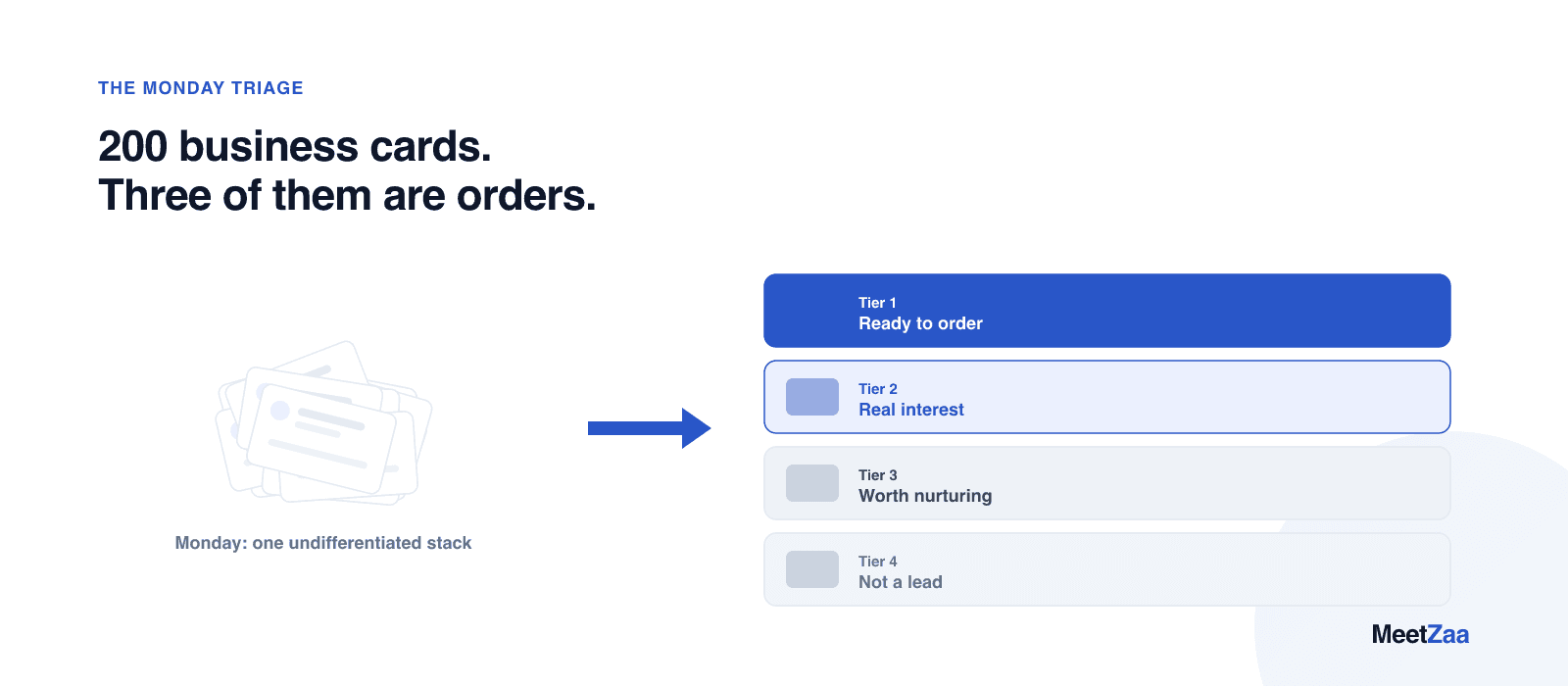
Block ninety minutes the first morning back and run the Monday Triage, a four-tier sort based on what each person actually said, not their job title. Go through the stack once, put each card in one of four piles, and do not overthink it.
![The Monday Triage: four tiers, four actions, four deadlines]
| Tier | How to spot it | What to do | By when |
|---|---|---|---|
| 1. Ready to order | Named a need, a timeline and a budget signal | Personal reply, quote or samples, from the named rep | Within 48 hours |
| 2. Real interest | Clear fit, but no urgency or not the decision-maker | Specific email referencing the conversation | Within 3 to 5 days |
| 3. Worth nurturing | Relevant, but early or exploratory | Add to a light touch sequence, revisit in a month | Within 7 to 10 days |
| 4. Not a lead | Brochure-grabber, job-seeker, competitor, wrong fit | Bin it, with no guilt | Now |
The whole value is in tiers one and four. Tier one is where the orders are, and it is small, usually a handful of cards. Tier four is bigger than you expect, and clearing it is what lets you spend real time on tier one instead of treating all two hundred as equal.
Do the sort in a single pass and trust your first instinct. If a card makes you hesitate, it is a tier two, not a tier one. The goal is not a perfect ranking. It is to find the few cards that deserve your morning, and to stop the other hundred and ninety from stealing it.
The triage only works if you kept the conversation
Here is the catch, and it is the reason most Monday stacks never get sorted well. Every tier above depends on remembering what the person said. From a bare card, you cannot, so tier one and tier four look the same and everything slides into a mushy tier two you never action.
Do the maths on a busy show. Two hundred cards, and clear memories of maybe forty. You can triage those forty. The other hundred and sixty default to guesswork, and the orders hiding in them get a generic email or nothing. The stack did not lose you the orders. The forgetting did.
A stack of cards is not a pipeline. It is a to-do list you have already started to forget.
The best Monday triage is the one you do not have to do, because the sort already happened at the stand. Capture the conversation when it is fresh, not the card, and each lead arrives already tiered.
MeetZaa does this with a thirty-second voice note per conversation. The need, the timeline and the promise are kept, the lead is scored, and the follow-up is drafted before your rep reaches the next visitor.
![Every conversation already sorted and scored, so there is no cold stack on Monday]
The sales head sees the whole show on a live board that night, hot leads already at the top. There is no stack to bring home, because the triage happened while the buyer was still standing there.
That is the real difference between the two Mondays. One starts with a rubber band and a fading memory, and most of it never gets actioned. The other starts with a ranked list and the notes already attached, so the only decision left is who to call first.
How to run your next Monday
You can fix this Monday with discipline, and the next show with a change of method.
- 1Block ninety minutes on the first morning back, before the inbox takes over.
- 2Sort the whole stack into the four tiers in one pass, going on what was said.
- 3Send tier one yourself, the same day, referencing the specific conversation.
- 4Queue tier two and three, then bin tier four without a second thought.
- 5For the next show, move the sort to the stand, so you never carry a cold stack home again.
The exhibitors who win the orders are not the ones with the fattest stack of cards. They are the ones who, by Monday lunchtime, know the three names worth calling and have already called them.
Questions exhibitors ask about business cards after a trade show
5What should you do with business cards after a trade show?
Sort them fast, before the memory fades. On the first morning back, put every card into one of four tiers based on what the person said, not their title: ready to order, real interest, worth nurturing, or not a lead. Then follow up the top tier personally within 48 hours and bin the bottom one without guilt.
How soon should you follow up after a trade show?
Reach your hottest leads within 48 hours and the rest within a week to ten days. The longer you wait, the less the buyer remembers of your conversation, and the more likely a faster supplier has already sent them a quote. Same-day is better still for anyone who named a timeline.
How do you prioritise trade show leads?
Score them on what they told you, not who they are. A named need, a timeline and a budget signal put a card in the top tier. Interest without urgency is the second tier. Curiosity is the third. Anyone who just wanted a brochure or a giveaway is not a lead and should not cost you time.
Should you enter every business card into your CRM?
Only after you have triaged them, and not all with equal effort. Entering two hundred strangers into a database before you have sorted them is how follow-up stalls. Enter the top tiers with the conversation notes attached, so whoever follows up knows what was discussed, and do not let the bottom tier clog the system.
How do you remember what each person said?
Write it down at the stand, not on Monday. A note on the back of the card, or a thirty-second voice note captured while the conversation is fresh, is what makes a real triage possible later. Relying on memory after a four-day show is why most stacks never get sorted properly.
Walk out of the show with every lead already moving
Scan the card, say what was discussed, and the follow-up is drafted before your rep reaches the next stand. Works offline.
Keep reading
Best Trade Show Lead Capture Apps in 2026
An honest comparison of Blinq, iCapture, Captello, Momencio, Cvent LeadCapture and MeetZaa — what each costs, who each suits, and where scanner rental still wins.
Arab Health exhibitor guide: capturing high-value medical leads
An Arab Health exhibitor guide for 2027, now World Health Expo Dubai, with the dates, a regulatory-buyer checklist, and how to capture high-value leads.
How to capture better leads at a trade show, not just more leads
More scans is not more pipeline. Here is the quality capture framework, the volume-versus-depth trade-off, and why capturing better beats capturing more.