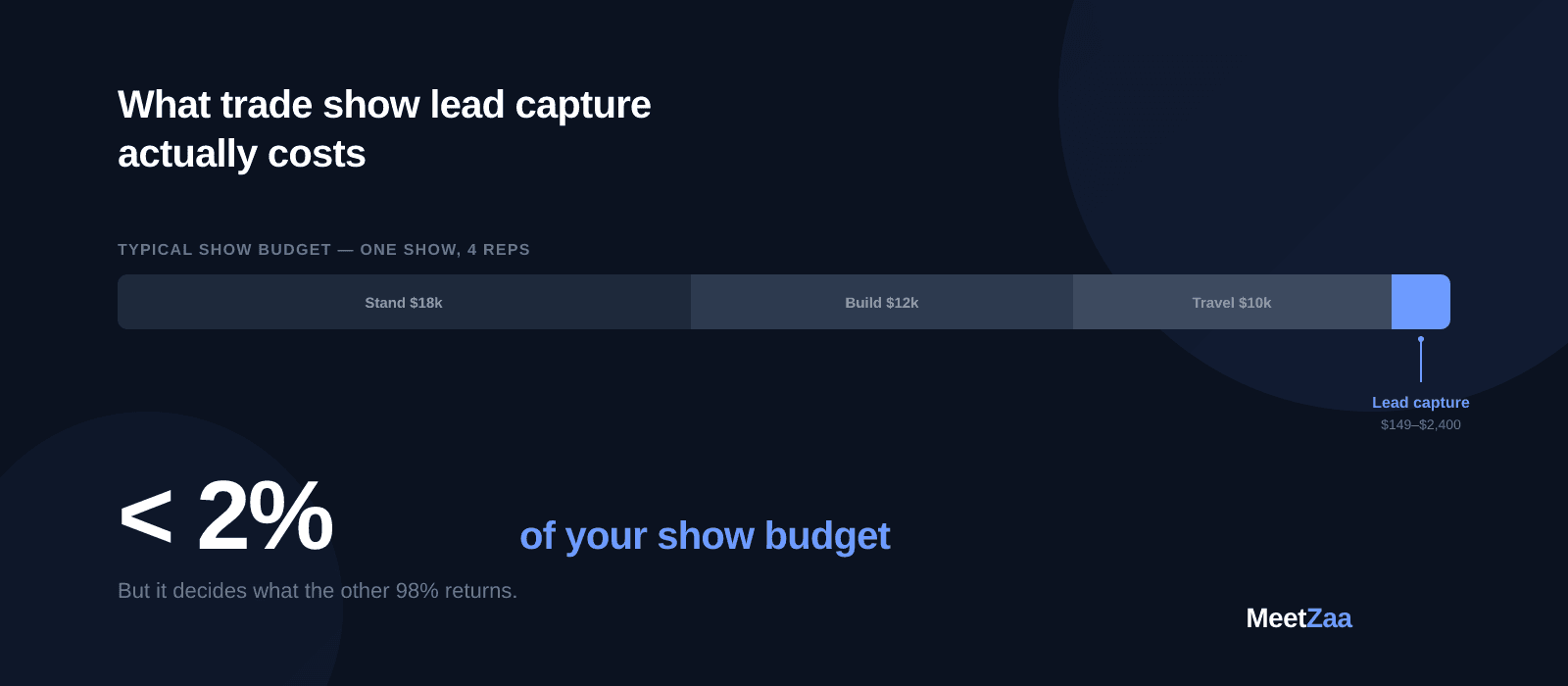
A mid-size stand at a Gulf exhibition costs roughly forty thousand dollars by the time you add the space, the build, the flights and the hotel for four people. The lead capture tool (whether it is a rented scanner or an app) adds from $99.
That is less than six per cent of the budget at the top end. Under one per cent at the bottom. It is the smallest line item on the exhibitor order form, and the one that decides whether the other $40,000 produces pipeline or a stack of badge scans that nobody opens.
What a show actually costs before anyone scans a badge
Here is a realistic budget for one show with a four-person team at a Gulf exhibition:
| Line item | Approximate cost |
|---|---|
| Stand rental (36 sqm) | $18,000 |
| Stand build and design | $12,000 |
| Flights and hotel (4 reps, 5 nights) | $10,000 |
| Lead capture | from $99 |
| Total | from ~$40,100 |
Organiser-provided scanner rentals run $400–700 per device on current exhibitor order forms, before processing fees, loss waivers and booth delivery. Four devices at one show land between $2,000 and $2,800. App-based tools start at $99 per show.
What that forty thousand dollars is supposed to produce
Break the show into the numbers a sales director actually reports on.
A mid-size stand with four reps produces roughly 80–100 visitor conversations across a four-day event. Not badge taps at a demo screen. Actual conversations where a rep spent five to ten minutes understanding what the visitor needs.
Of those, perhaps 15–25 are genuinely qualified: the visitor has a need your product fits, a timeline, and something close to budget authority. Those are the leads the show exists to produce. The stand, the flights, the build: all of it is infrastructure to make those conversations happen.
The return on the show depends on how many of those conversations become pipeline within the first week. That is the number the MD sees. Not footfall, not badge scans. Orders that trace back to a conversation on the stand.
Where the return disappears
of trade show leads are never followed up, according to research widely attributed to the Center for Exhibition Industry Research
The number is not about lazy salespeople. It is about what happens between Thursday afternoon on the stand and Monday morning at the desk.
Your rep has a conversation with a procurement director from Sharjah who needs bulk pricing for twelve months. A real opportunity. But the only record is a scanned badge: a name, a company, an email. By Monday, four reps have eighty badge scans between them and no structured record of who needed what.
The follow-up, if it goes out, is generic. The procurement director gets the same "great meeting you" email as the person who spent thirty seconds at the demo screen. The reply rate tells the story.
Run the numbers for a team doing six shows a year. Each show produces ninety conversations and twenty qualified leads. At 80 per cent unfollowed, that is sixteen lost per show. Ninety-six across the year.
If one in five of those would have converted at an average order value of $5,000, that is roughly nineteen lost orders. $96,000 in pipeline that never opened. In AED, about 350,000 dirhams a year in conversations that happened on the stand and disappeared on the flight home.
The most expensive line item at a trade show is not the stand or the scanner. It is the conversations your team had on Thursday that nobody can reconstruct on Monday.
Why badge data does not survive the flight home
A badge scan gives you who someone is. It does not give you what they need.
The scanner (rented handheld or app) captures printed data: name, company, title, email, phone. Some add qualifying tick-boxes the rep fills in between conversations. That produces a contact record. It does not produce a lead.
What matters for follow-up is what the visitor asked for, what timeline they gave, what your rep promised, and whether they are comparing you to a competitor. That is the conversation. It lives in the rep's memory for about forty-eight hours, then it degrades.
By day three, the director who wanted bulk pricing for twelve months and the browser who picked up a brochure look like the same line on a spreadsheet.
This is why the 80 per cent figure persists. Teams do not forget to follow up. They lose the information that would make the follow-up worth sending.
What recovering those conversations is worth
Take the same team: six shows, twenty qualified conversations each, sixteen lost per show. Ninety-six leads a year that had a genuine conversation on the stand and received nothing useful afterwards.
Recover half. Not all. Half. That is forty-eight leads that now get a follow-up referencing what they asked for, what was discussed, and what was promised. At a 20 per cent close rate and $5,000 average order value, that is roughly ten extra orders: $48,000 in revenue that was already sitting on your stand.
![How qualified leads are lost between the stand and the follow-up, and what is recoverable]
The cost of recovering those conversations is a thirty-second voice debrief after each one. The rep steps away, records what happened in their own words, and the AI turns it into a structured lead (a summary, a score, and a drafted follow-up email) before they reach the next visitor.
MeetZaa does this from $99 per show, no contract. The admin sees every conversation on a live board across the whole team.
The eleven questions that separate a capture tool from a lead tool go beyond pricing.
How to calculate your own number
Three figures decide whether your current setup is leaving pipeline on the table:
- 1Qualified conversations per show: estimate from last year, or take 20–25% of total visitor conversations
- 2Follow-up rate: how many received a personalised follow-up within 48 hours referencing what was discussed
- 3Average order value: the revenue from one closed deal
Multiply the gap between qualified and followed-up by your close rate, then by your order value. That is the pipeline the current tool is leaving behind, per show.
A team with twenty qualified conversations, four followed up, a 20 per cent close rate and a $5,000 order value is losing roughly $16,000 per show in recoverable pipeline. Across six shows, that is close to $100,000 a year.
The capture tool's job is not to be cheap. It is to close that gap.
Pull your next quarter's show calendar and run the numbers. The right tool is the one where the cost of capture is a rounding error against the pipeline it recovers.
Questions exhibitors ask about lead capture costs
4How much does trade show lead capture cost?
From $99 per show, depending on the method. Organiser-provided scanner rentals run $400–700 per device on current exhibitor order forms, and a four-person team pays $2,000–$2,800 for a single event. App-based tools start at $99 per show with no rental fees or hardware.
What is the average cost per lead at a trade show?
Industry figures vary widely depending on what costs are included: stand rental, staff travel, build and capture tools all factor in. The more useful question is your fully loaded cost per qualified lead, which means dividing total exhibition spend by leads that actually received meaningful follow-up.
Is trade show lead capture worth the cost?
The cost of not capturing leads properly is almost always higher than the tool. If 80 per cent of qualified leads go unfollowed and each lost order is worth $5,000, a team at six shows a year can leave $96,000 or more in pipeline on the table. MeetZaa captures the conversation (not just the badge) through a thirty-second voice debrief that scores the lead and drafts the follow-up before the rep reaches the next visitor.
What is the real cost of not following up trade show leads?
For a team doing six shows with twenty qualified leads per show, losing 80 per cent to poor capture means roughly ninety-six missed follow-ups a year. At a 20 per cent close rate and $5,000 average order value, that is close to $100,000 in pipeline that never opened, far more than the cost of any capture tool.
Know what the show was worth before you book the next one
Every conversation captured, scored and followed up means the ROI question finally has an answer you can show a CFO.
Keep reading
Best Trade Show Lead Capture Apps in 2026
An honest comparison of Blinq, iCapture, Captello, Momencio, Cvent LeadCapture and MeetZaa — what each costs, who each suits, and where scanner rental still wins.
Arab Health exhibitor guide: capturing high-value medical leads
An Arab Health exhibitor guide for 2027, now World Health Expo Dubai, with the dates, a regulatory-buyer checklist, and how to capture high-value leads.
How to capture better leads at a trade show, not just more leads
More scans is not more pipeline. Here is the quality capture framework, the volume-versus-depth trade-off, and why capturing better beats capturing more.