[Buyer type field guide]
A woman stops at your stand, glances at your destination, and says she is sourcing for the German and Nordic markets for next season. Your rep nods and scans her badge.
Nobody writes down which markets, or that she runs a destination management company and not an online agency. By the time you follow up she is one more name who "seemed interested."
At a travel show, "a buyer" is not one thing. A DMC, an online agency, a corporate travel manager, a tourism board and a MICE planner all walk the same aisles and scan into the same app, and they buy in completely different ways. The exhibitors who win know which one they are talking to before the conversation ends.
This guide covers WTM London 2026, a field guide to those buyer types, and how to capture the detail that turns a scanned badge into a travel contract.
WTM London 2026, and why the buyer type matters
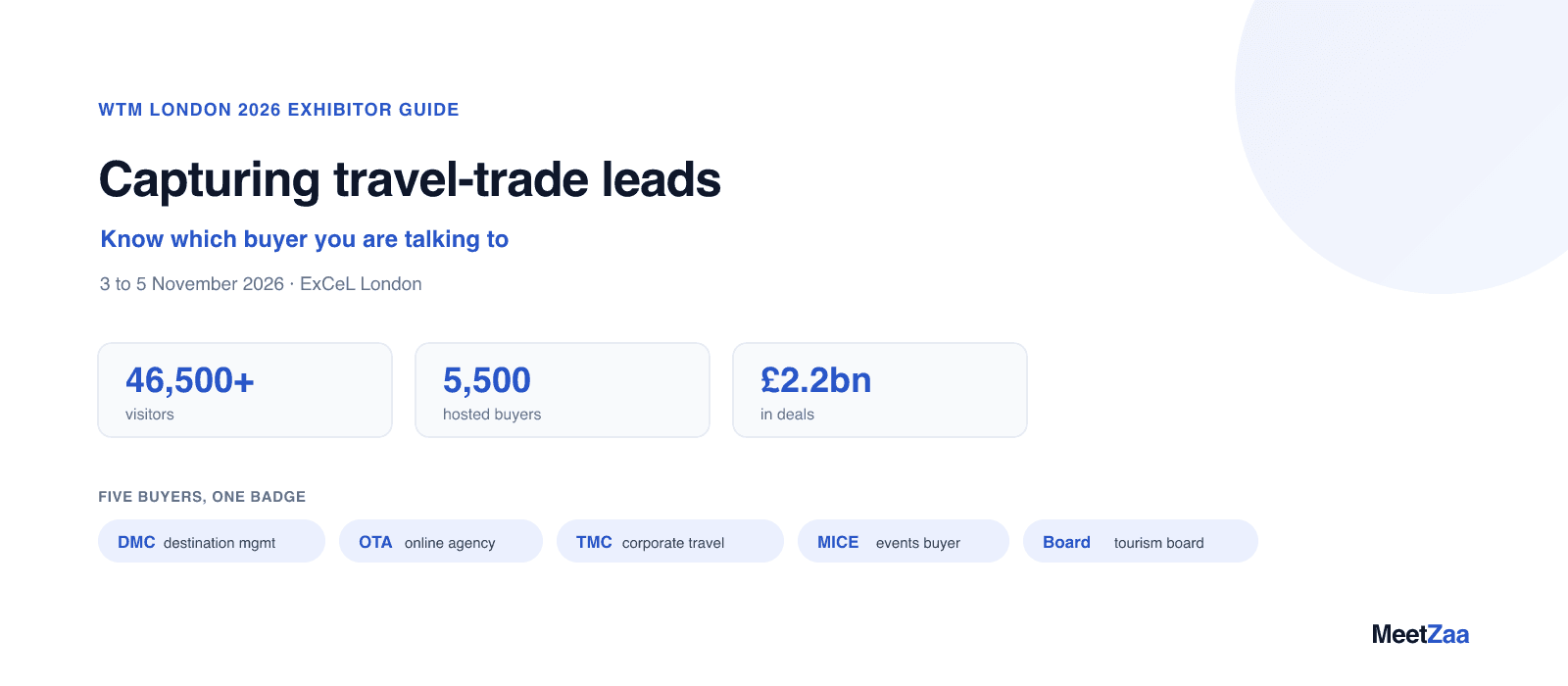
WTM London 2026 runs from 3 to 5 November 2026 at ExCeL London. It is the largest travel trade show in Europe, and the organiser reports 46,500 visitors, more than 5,000 exhibitors, and 5,500 hosted buyers from over 150 countries.
It is a meeting-dense show. The organiser reports more than 40,000 business meetings in a single edition, many of them pre-booked through the hosted buyer programme.
in travel deals done at WTM London in a single edition, the organiser reports
Two things follow from that. Travel contracts are largely annual, so one qualified buyer can be a whole season of business, which makes each conversation worth far more than at a high-volume consumer show. And because the buyers are so different from one another, the same scanned badge can mean five different opportunities, each needing a different follow-up.
For Indian exhibitors this runs both ways. Inbound DMCs and hotel groups come to WTM to reach the European and global operators who send clients to India, and state tourism boards come to promote destinations to the trade.
The buyer in front of you might be sourcing India for a German operator, or trying to sell you a source market of their own. Reading which is which is the first move of the show.
The buyer-type field guide
Before the show, brief your team with the buyer-type field guide. It decodes the acronyms and, more usefully, tells each rep what each buyer came to source and what to ask them.
![The travel buyer-type field guide: who they are and what they came to source]
| Buyer type | What they are | What they came to source | What to ask |
|---|---|---|---|
| DMC | Destination management company, the local operator in a destination | Hotels, ground services and experiences to package | Which source markets, which season, allotment and rates |
| Tour operator or OTA | Sells travel to consumers, offline or online | Product and rates to resell, by volume | Which markets, what volume, which season's contract |
| TMC | Travel management company, handles corporate travel | Hotel and rate agreements for business travellers | Corporate demand, RFP cycle, which cities |
| MICE buyer | Sources venues and services for meetings and incentives | Venues, DMCs and group services for events | Event type, group size, dates and destinations |
| Tourism board | Promotes a destination, not a direct buyer | Partnerships and co-marketing, not a sale | Campaigns, joint promotion, trade training |
The field guide does two jobs. It stops a rep spending twenty minutes selling a rate contract to a tourism board that cannot buy one, and it makes sure that when a real buyer stops, the rep captures the one thing that matters: which markets, which season, which contract.
Why a scan flattens buyers who are nothing alike
Here is the trap. A DMC sourcing hotels for the German market and a tourism board looking for a co-marketing partner both scan into the app as a name, a company and a title. On the badge they look identical. In reality they need opposite follow-ups, one a rate proposal, the other a partnership deck.
At a travel show, "a buyer" can mean five different businesses. The follow-up that wins knows which one it is talking to.
Send both the same "great to meet you at WTM" email and both ignore it. The scan captured who they were, not what they were sourcing, so the follow-up cannot be specific, and at a show where the real business is annual contracts, a generic reply is a lost season.
This is what MeetZaa captures on the stand. A thirty-second voice note records the buyer type, the markets they source for, the season and the contract they want, as a structured lead, scored and with the follow-up drafted to match. The hosted buyer programme is essential for booking the meetings; capturing what happens in them is still your job.
Do the maths for a travel exhibitor at WTM. Across three days you might hold sixty meetings, pre-booked and walk-up. If you can recall the exact markets and season for only fifteen, the annual contracts hiding in the other forty-five go to whichever exhibitor followed up with the right markets named. The meetings were not wasted. The detail was.
The follow-up window is a season, not a week
Travel runs on a contracting calendar. Operators and DMCs meeting at WTM in November are building programmes for the next season, and the rate and allotment decisions get made in the weeks straight after the show. That is a narrow window, and it is why a specific, fast follow-up matters even more here than at a general show.
Miss it and you do not lose a lead, you lose a season. The operator has already contracted the hotel or destination that replied first with the right markets and rates. The annual nature that makes each WTM buyer so valuable is the same thing that makes each missed follow-up so expensive.
How to work WTM as a travel exhibitor
WTM rewards preparation more than footfall, because the best buyers are pre-booked and the deals are annual.
- 1Apply early and pre-book hosted buyers through the programme, in your target source markets.
- 2Brief the team on the buyer-type field guide, so every rep can tell a DMC from a tourism board.
- 3Agree what to capture from each type: markets, season, volume and contract.
- 4Capture it on the stand, by buyer type, not from memory on the flight home.
- 5Follow up within 48 hours with a reply that names the buyer's markets and season.
At WTM the winners are not the exhibitors with the most scans. They are the ones who knew which buyer they were talking to, captured which markets each was sourcing for, and followed up before the season's contracts were signed elsewhere.
Questions travel exhibitors ask about WTM London
5When and where is WTM London 2026?
WTM London 2026 runs from 3 to 5 November 2026 at ExCeL London. It is the largest travel trade show in Europe, with more than 46,500 visitors, over 5,000 exhibitors and 5,500 hosted buyers from over 150 countries, according to the organiser.
What is a hosted buyer at WTM?
A hosted buyer is a qualified travel trade buyer whom the organiser supports to attend, in exchange for a schedule of pre-booked meetings with exhibitors. Applying to meet hosted buyers in your target source markets is the single most valuable piece of WTM preparation, because it fills your diary with buyers who can actually contract.
Who are the buyers at WTM London?
A mix that behaves very differently: destination management companies, tour operators and online travel agencies, travel management companies, MICE buyers, and tourism boards. Some want rate and allotment contracts, some want product to resell, and some want partnerships rather than a sale. Knowing which is which is the core of qualifying at WTM.
Is WTM London worth it for exhibitors?
It can be very worth it, because travel deals are annual and the show is dense with pre-qualified buyers, so a single contract can justify the stand. The organiser attributes over £2.2 billion in deals to a single edition. The return depends on pre-booking the right buyers and capturing what each one was sourcing for.
How do you follow up travel trade leads?
Match the follow-up to the buyer type and the markets they named. A DMC wants rates and allotment for specific source markets and a season, a tourism board wants a partnership, and a corporate travel manager wants a rate agreement. Reference their exact markets and season within 48 hours, which is only possible if you captured them on the stand.
Field guide
Walk out of the show with every lead already moving
Scan the card, say what was discussed, and the follow-up is drafted before your rep reaches the next stand. Works offline.
Keep reading
Best Trade Show Lead Capture Apps in 2026
An honest comparison of Blinq, iCapture, Captello, Momencio, Cvent LeadCapture and MeetZaa — what each costs, who each suits, and where scanner rental still wins.
Arab Health exhibitor guide: capturing high-value medical leads
An Arab Health exhibitor guide for 2027, now World Health Expo Dubai, with the dates, a regulatory-buyer checklist, and how to capture high-value leads.
How to capture better leads at a trade show, not just more leads
More scans is not more pipeline. Here is the quality capture framework, the volume-versus-depth trade-off, and why capturing better beats capturing more.